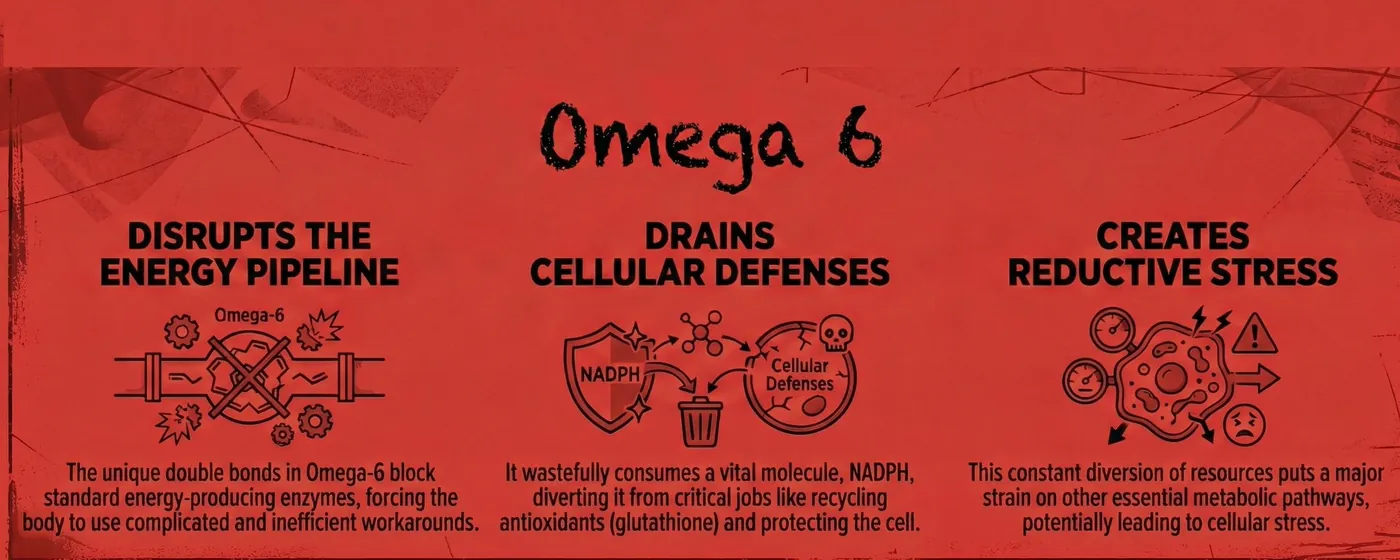
Omega 6 to ATP
After covering the Oxidation process of glucose and saturated fats, It's now time to talk about the Unsaturated fats Omega 6 aka Linoleic Acid.
I suggest reading first my "Glucose to ATP", Then "Saturated Fats to ATP"
To fully understand oxidation of omega 6.
Unsaturated fats has double bonds between their Carbons, When a double bond appears each carbon atom can connect to only 1 Hydrogen atom instead of 2.
The location of the first double bond from the methyl group (C-H3) aka the omega end will determine it's name.
Linoleic Acid is called Omega 6 because the first double bond is 6 carbons away(counting from the methyl carbon)which is C18, So C12=C13,
Linoleic has another double bond at C9=C10 which is problematic as we shall see.
We'll begin activation, breaking ATP to AMP so Co-enzyme A can attach it's Thiol(S) group to the fatty acid.
Then with 3 rounds of Beta Oxidation just like in saturated fats that will create 3 Acetyl Coa molecules from carbons 1-6.
β-oxidation gave 1 NADH + FADH = 4 ATP
Each Acetyl Coa will produce 2 molecules of CO₂ + 10 ATP
3 rounds =42 ATP, reduce 2 ATP invested in activation = 50 ATP
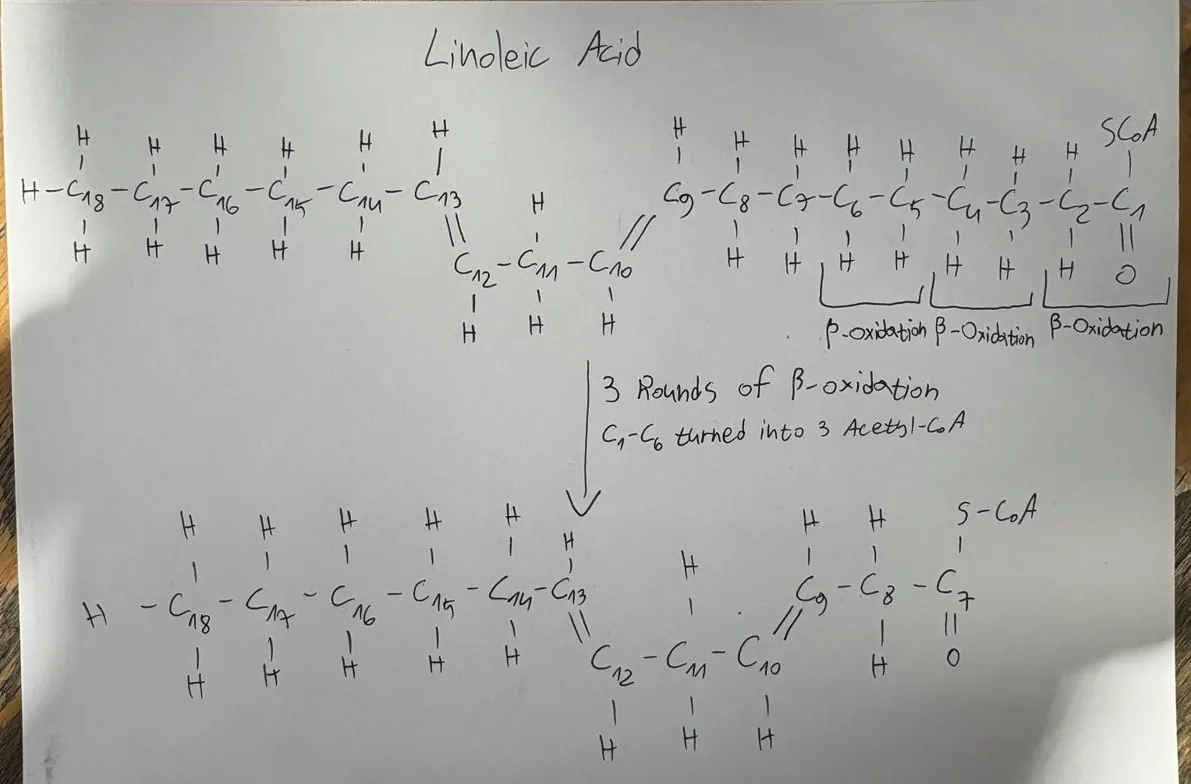
Now we have a problem, FAD that is supposed to take 1 Hydrogen atom from C9 and 1 from C8 cannot accept those because C9 has only 1 Hydrogen atom.
so a different step will occur that skips the formation of FAD.
The enzyme Enoyl CoA Isomerase will move the double bond to C8=C9.
Then beta oxidation will continue(Hydration,NAD Oxidation ,Thiolase)
generating 1 Acetyl CoA + NADH = 12.5 ATP
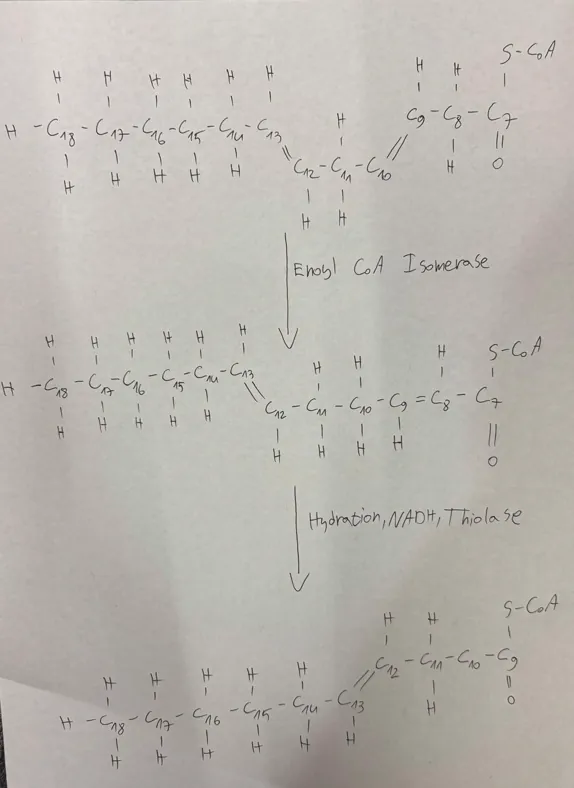
Now we have a 10 carbon fatty acid
Next step of beta oxidation is FAD again which now can take Hydrogen from C10 & C11
And generate 1.5 ATP.
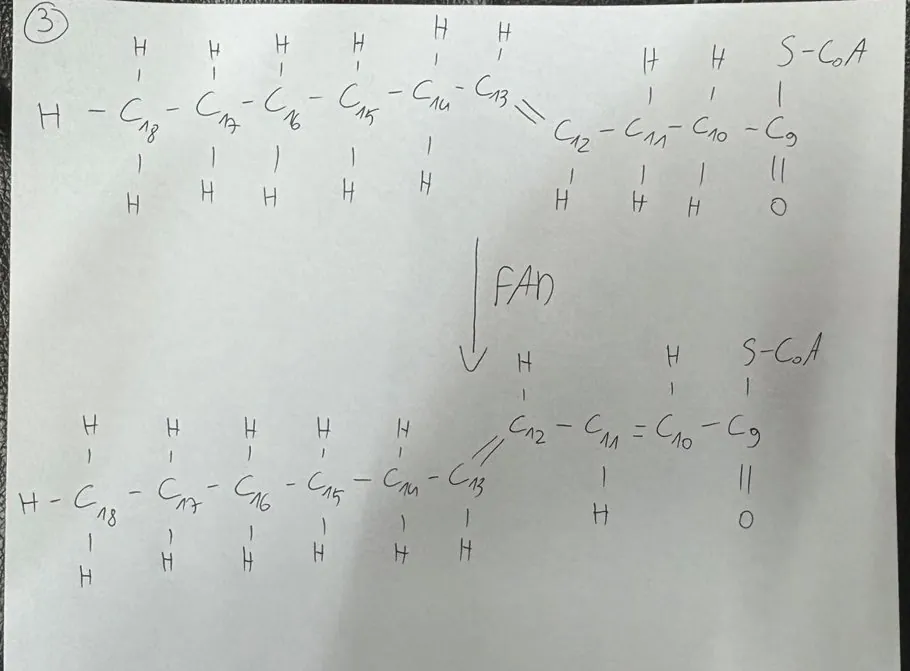
the next step is you already know is supposed to be hydration,
Enoyl-CoA Hydratase is designed to add water to an isolated double bond. The presence of an additional double bond at C12=13 alters the molecule’s electronic structure and the bond angle, preventing the enzyme from binding or functioning.
To overcome this issue, the enzyme 2,4-Dienoyl-CoA reductase is recruited. It uses the reducing power of NADPH to donate two electrons and two protons to the conjugated system. This reaction "breaks" the stable resonance of the two double bonds, merging them into a single double bond located at C12=C11.
This is a major problem with Unsaturated fats that makes it harder to oxidize, In a less elegant structured manner compared to Glucose or Saturated Fats, In addition using NADPH to oxidate fats is really wasteful, Prevents directing NADPH toward critical cellular defense systems such as the recycling of glutathione or toward biosynthetic pathways, it is consumed to repair the structural hurdles of unsaturated fats. This diversion of resources puts a strain on the Pentose Phosphate Pathway and can lead to Reductive Stress. In better words oxidating unsaturated fats Lacks the Elegance of glucose/saturated fats.
2,4-Dienoyl-CoA reductase merging the double bonds into a single double bond located at C12=C11.
Enoyl-CoA Isomerase will move the double bond one carbon from C12=C11 to C11=C10, this will allow Hydration.
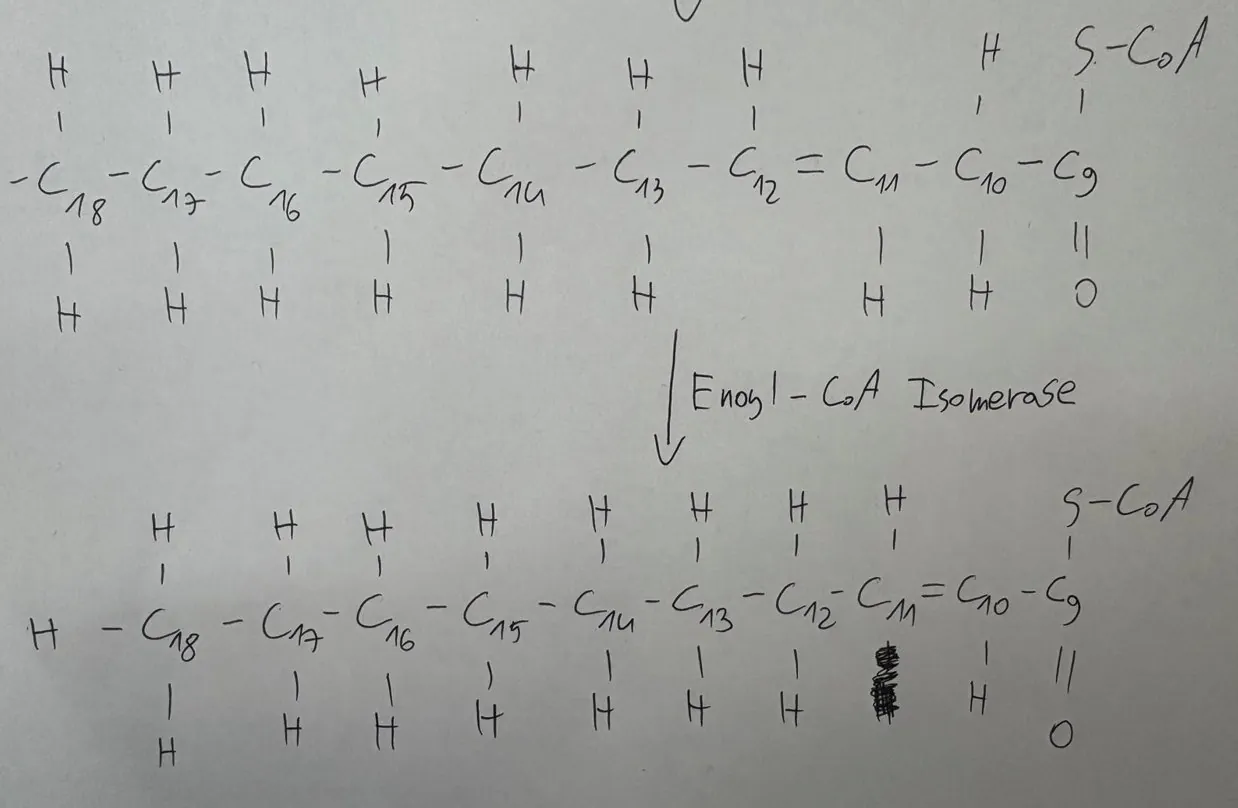
Now Hydratase can add O-H to C11 and H to C10
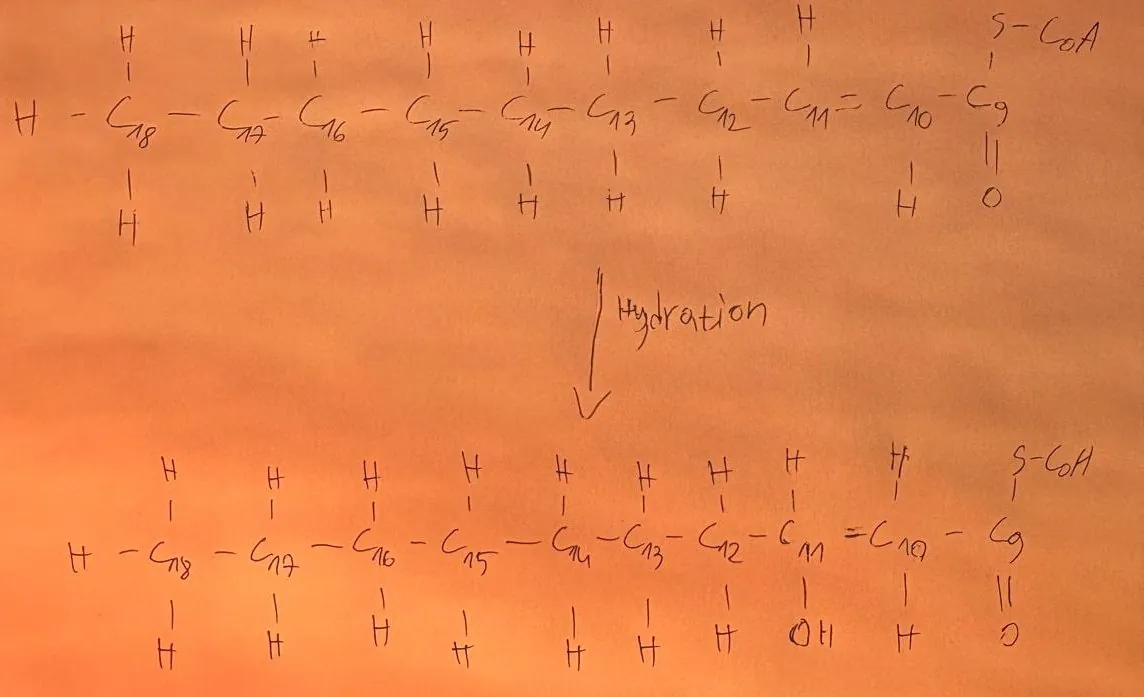
Then NADH+Thiolse
1 Acetyl Coa will be created = 10 ATP
NADH = 2.5 ATP
together 12.5 ATP
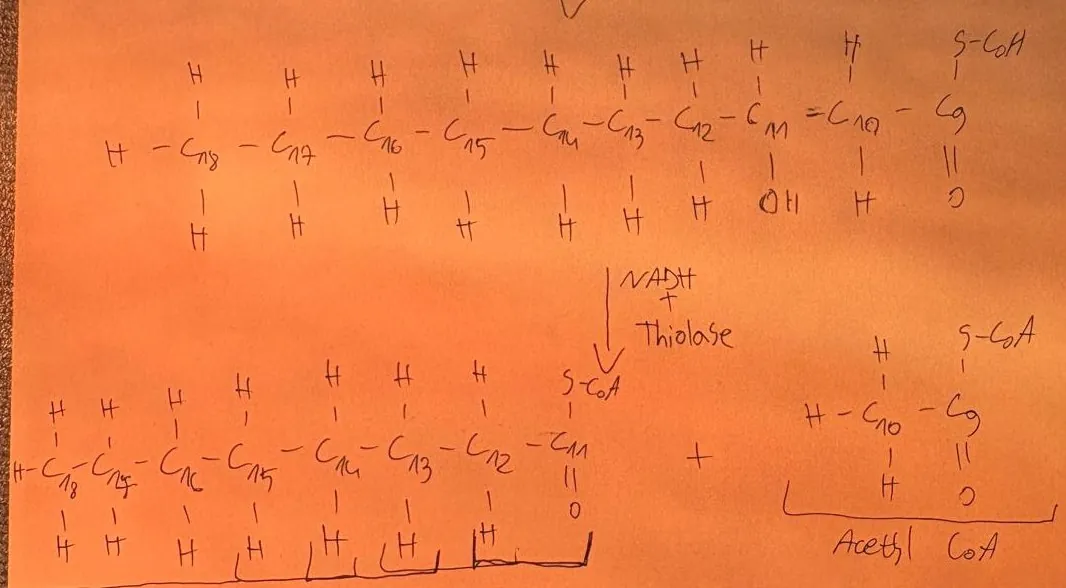
Now we have a Carbon saturated fatty acid
That will under go 3 Beta oxidation rounds to produce 4 Acetyl Coa
12 ATP + 40 ATP = 52 ATP
All steps combined:
40 + 12.5 +1.5 + 12.5 + 52 = 118.5 ATP
Important Note
As we can see omega 6 oxidation is far less elegant than saturated fat oxidation.
Oxidating pufa consumes NADPH, stresses the body which need to create more NADPH, It will do so by turning on the pentose phosphate pathway(PPP), a metabolic side route that shifts glucose metabolism to generate NADPH rather than ATP.
This phase produces NADPH while releasing carbon dioxide, meaning glucose carbons are wasted instead of generating cellular energy.
Now enters the enzyme Fatty acid synthase(FAS), The enzyme that turns carbs to fat. He is strictly NADPH dependent, At the same time, glucose carbons that no longer enter oxidative metabolism are funneled to generate cytosolic acetyl CoA Instead of mitochondrial Acetyl CoA.
Together, abundant NADPH and cytosolic acetyl CoA shift metabolism away from efficient energy production toward fatty acid synthesis and fat storage rather than ATP generation.
This why eating pufa will decrease metabolic rate, block glucose metabolism and cause fat gain, Obesity is an epidemic that is blamed on genes while seed oils consumption exploded in the last decade and via the mechanism listed above causes metabolic disorders like diabetes or cancer.
Hope you found this information useful
Stay Oxidated!