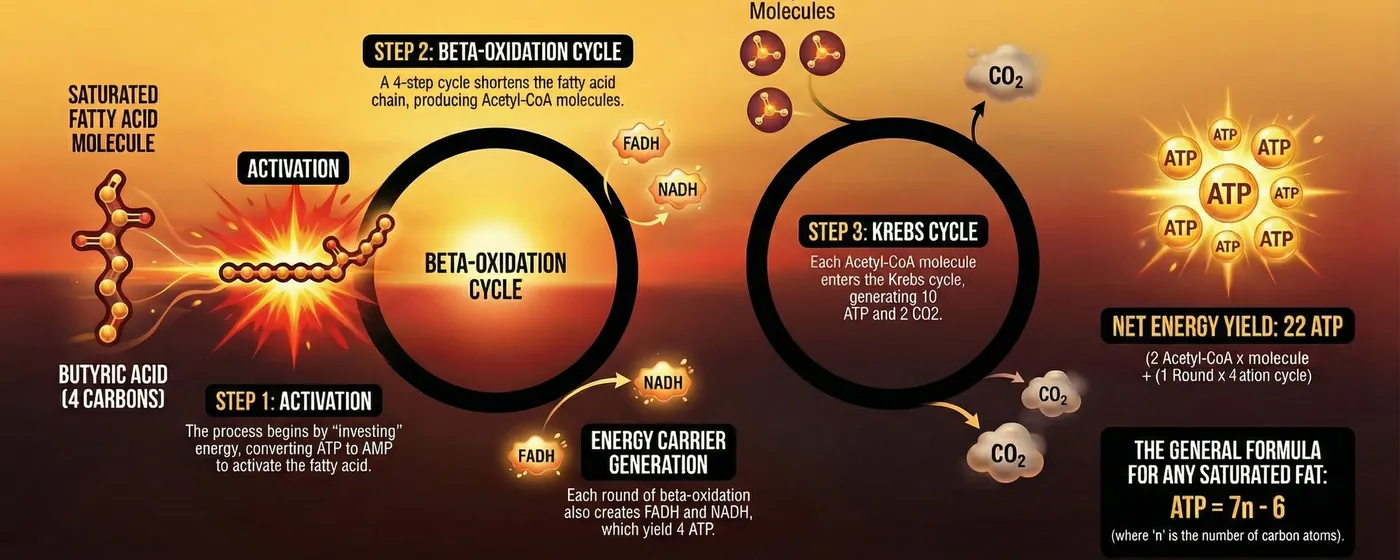
Saturated Fats to ATP
In this article I'll review the Oxidation process of Saturated fatty acids, Oxidation of fats is a bit more complex then glucose oxidation so you should read first my article "Glucose to ATP" it will help you understand Acetyl-CoA and Krebs cycle.
Fatty acids differ in their carbon chain, Hydrogen Saturation
All Fatty acids contain:
Carboxylic Group : C-O-OH, It's Hydrophilic, Acidic, Functions as the reactive part that will bind the Acetyl CoA.
Methyl Group: C-H3, It's Hydrophobic, Stable, also called the Omega group from which omega 3,6,9 is counted.
We'll begin with the easiest Fatty Acid to oxidize-Byuteric Acid
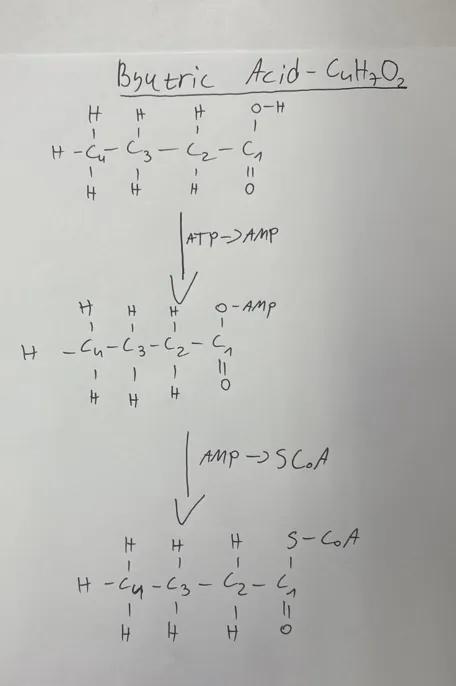
The First step is to activate the fatty acid by investing the energy of breaking ATP to AMP, This will allow the highly active
Co-enzyme A to attach it's Thiol(S) group to the fatty acid
Now Beta Oxidation can begin
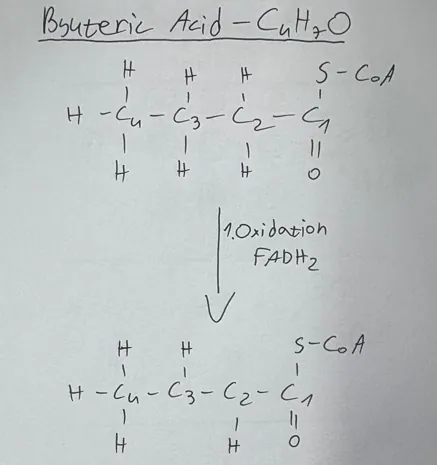
A 4 step process that will create 2 Acetyl CoA molecules.
First step: The enzyme Acyl-CoA Dehydrogenase removes two hydrogen atoms, One from C2 and one from C3,they get picked by FAD that becomes FADH and HE carries them to the ETC.
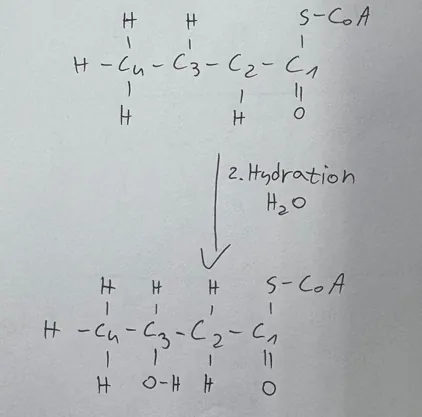
Second step: Hydration, water molecule is added
2 Hydrogens and 1 Oxygen.
Third step is similar the first, 2 Hydrogens atoms are removed from C3, NAD turns to NADH, delivers them to the ETC.
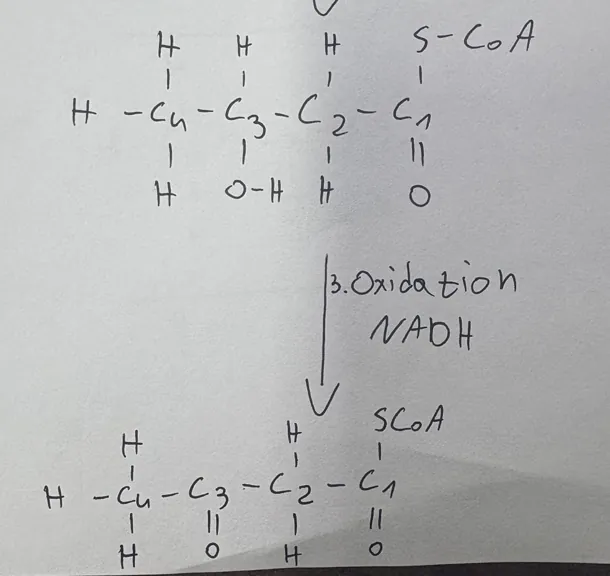
Last step is done by the enzyme Thiolase that cuts in half the molecule, The left group connects to a S-CoA group, Hydrogen atom is added toThe right one.
We now have 2 molecules of Acetyl-CoA .
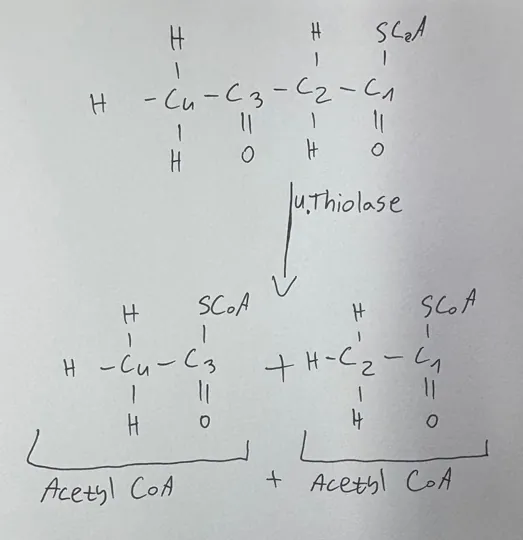
Each Acetyl-CoA molecules undergoes krebs cycle.
As showed in my "Glucose to ATP" Article,krebs cycle generates:
2 molecules of CO₂ + 10 ATP
1 round of β-oxidation gave 1 NADH + FADH = 4 ATP
Total: 24 ATP
-2 ATP (activation step ATP --> AMP)
Byuteric acid will generate 22 ATP + 4 CO2
Let's continue to Hexanoic Acid that has 6 carbons.
It will under go Activation(ATP ->AMP) Then 1 Round Of Beta Oxidaion and will become Byuteric acid + Acetyl CoA
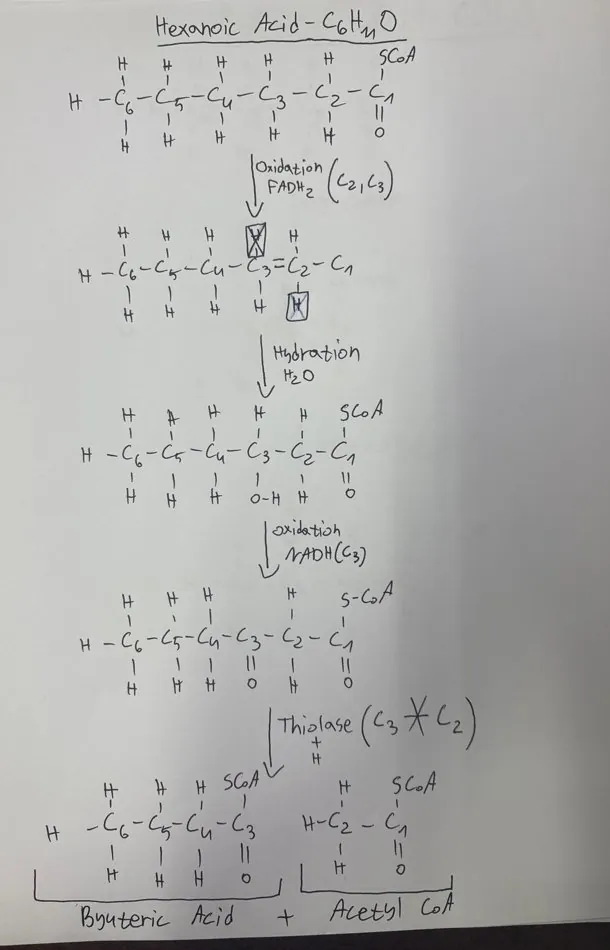
1 round of β-oxidation is NADH+FADH= 4 ATP
1 round of krebs cycle = 2 CO2 + 10 ATP
Byuteric acid = 22 ATP + 4 CO2
Hexanoic acid will generate 36 ATP + 6 CO2
From here it's simple math, Let's assume
n = Numbers of Carbons
Then
n/2 = Acetyl-CoA Molecules
Each gives 10 ATP and 2 CO2
n/2 -1 = Rounds of β-oxidation
Each gives 4 ATP
Activation = -2 ATP
Combine everything
ATP = 7n-6
CO2 = n
I Hope you'll find this useful.
Tomorrow I'll probably write how Unsaturated Fats break down to ATP.
#fats#seedoils#saturatedfats#metabolism#oxidativestate