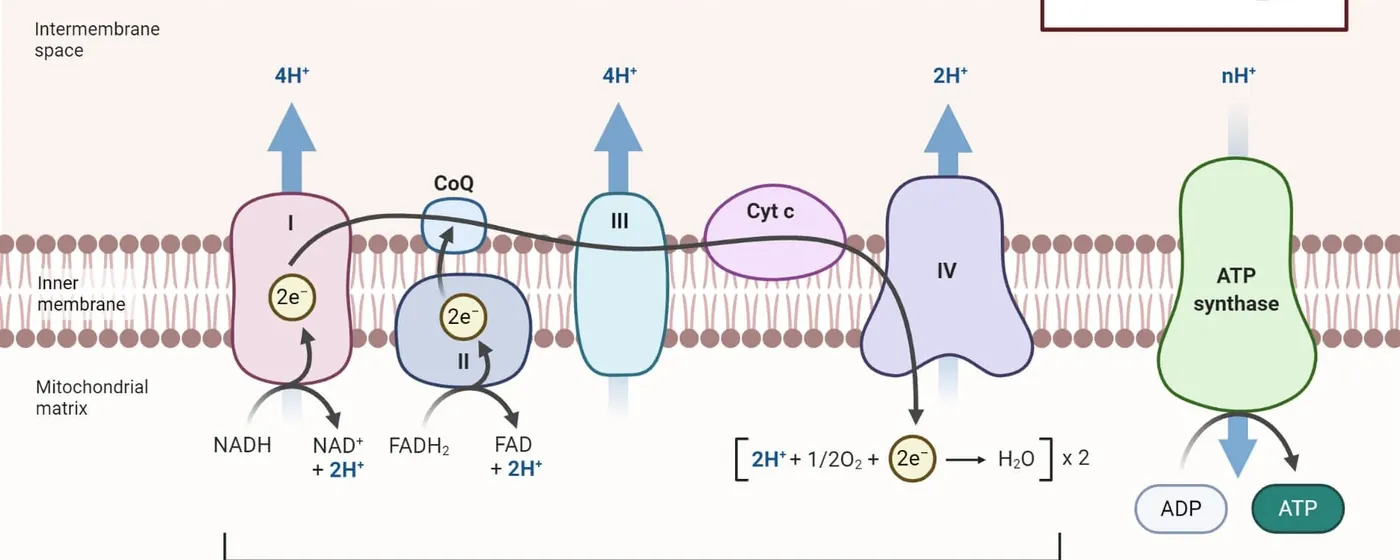
The Electron Transport chain
The electron transport chain is a unique supercomplex responsible for generating 90% of the total ATP.
It lies on the inner mitochondrial membrane, Transfers electrons in a structured manner through 4 complexes, some of them convert redox energy(electrons) to mechanical work that pump protons to the Intramembrane space and create pressure as proton gradient that builds up and allows the last complex (ATP Synthase) to use the energy of the gradient to produce ATP.
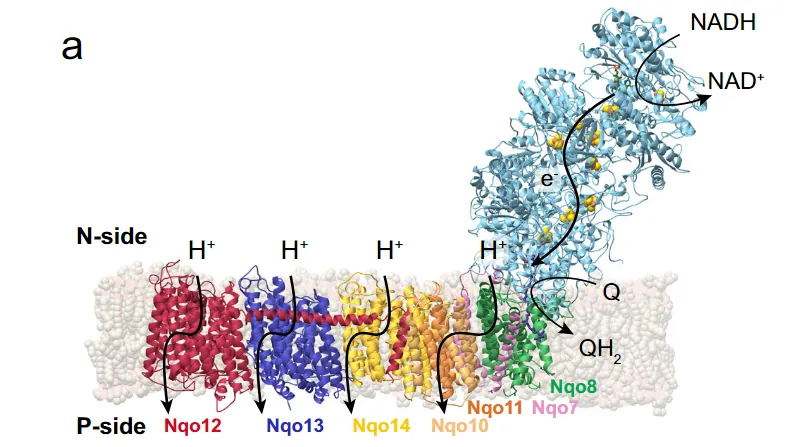
Complex I : NADH binds to the complex and gets oxidized back to NAD by giving 2 electrons to FMN(Riboflavin-5-phosphate) an analog to B2 that passes his electrons to Iron-Sulfur clusters, A series of linear cluster of Fe-s that form an electron wire 10nm in length that allows electrons to pass one by one, connecting FMN to Ubiquinone(Co-Enzyme Q10)
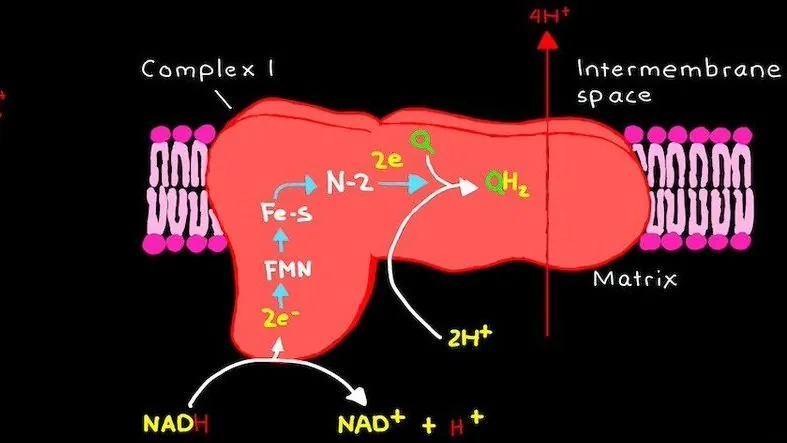
when Ubiquinone reduced by the electrons an electric charge gets distributed between a series of antiporter-like subunits called Nqo(NADH Quinone oxidoreductase) that pump 4 protons to the Intramembrane space.
Complex II
This complex is directly connected to the Krebs Cycle, when Succinate is oxidized to fumarate reducing FAD to FADH2, the complex transfers the electrons to other Iron-Sulfur clusters that also connects to Ubiquinone(Co-Enzyme Q10) BUT without pumping protos to the Intramembrane space, This step is not helping in generating ATP making it less important than Complex 1, This complex shows the difference between NAD and FAD and shows that NAD is much more beneficial for ATP generation than FAD and why oxidizing carbs is much better than oxidizing fats.
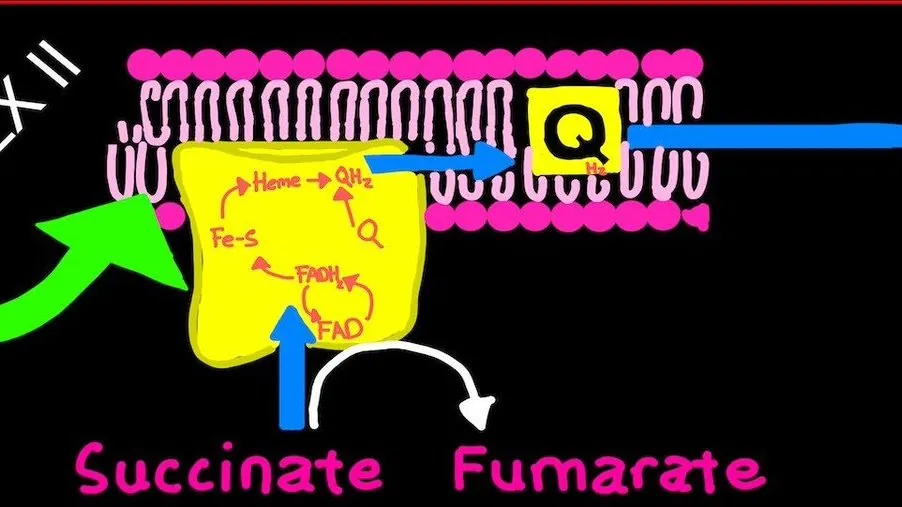
CoQ10 can travel within membrane, when he gets reduced by complex 1 or 2 he moves to Complex III.
Complex III (Cytochrome b-c1)
Cytochromes are protein complexes with an Iron Heme that can alternate between a reduced Fe2 and an oxidized Fe3
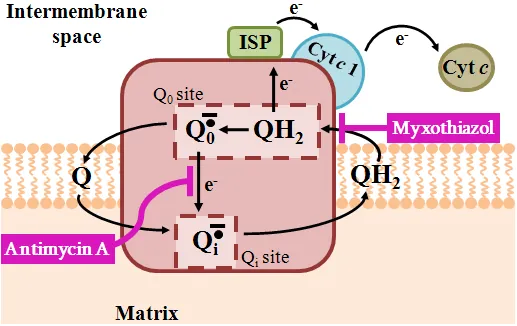
Ubiquinol binds the complex(at the Q0 site) and releases two protons directly into the intermembrane space,
Initiates the Q cycle:
One electron from Ubiquinol through iron sulfur proteins to cytochrome c1 and then to cytochrome C.
Cytochrome c is a simple docking station between Complex 3 to complex 4, the heme iron in it enables only 1 electron to pass to complex 4.
Second electron goes into cytochrome b that serves as a tunnel that leads the electron to Ubiquinone at a recycling Cite called Qi, Where Ubiquinone semi-reduced and will wait for another Q cycle to accept another electron Ubiquinol, then it will go again to the Q0 cite cause another 2 protons to pump to the intermembrane space.
Ubiquinone molecules serve here a crucial role and solves a major problem, Cytochrome C can recieve only 1 electron at a time, so by feeding the Q cycle with 2 electrons and picking up 1 electron they allow organized feeding of cytochrome C and increase in proton gradient each time they drop the electrons at Q0 cite.
Complex 4 : Cytochrome c oxidase
electrons from cytochrome c enter, A CuA center that contains 2 copper atoms and passes electrons quickly to a special center called "Heme a3 CuB" this center collect one electron each time, When he has 4 electrons he binds O2 molecule and break her bond to O O, Then binds 2 electrons and 2 matrix protons to each Oxygen and creates 2 water molecules.
O2 + 4H + 4e → 2H2O
In this process 4 protons from the matrix get consumed, and 2 protons get pumped to Intramembrane space
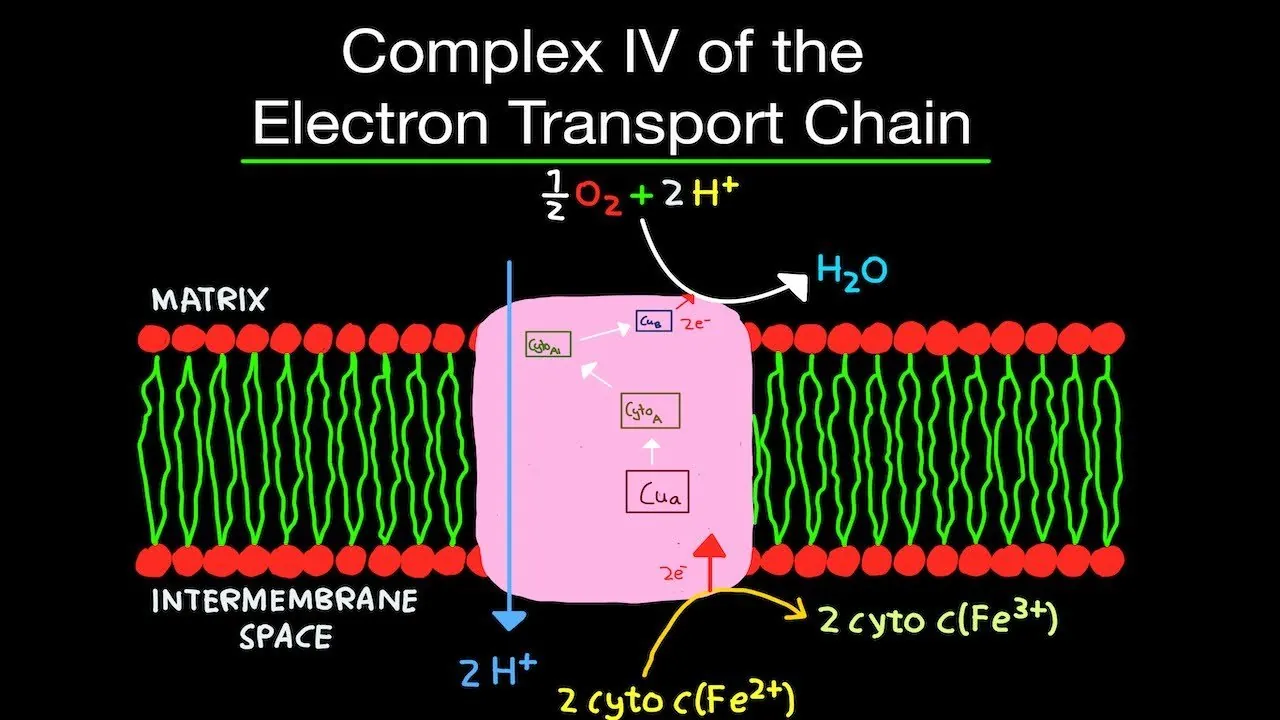
In total 10 protons pumped for a pair of electrons passing.
This is the whole purpose of the ETC
Now comes the beautiful part.
ATP Synthase
Probably the most important complex in our cells, Uses the difference in proton gardient(Proton Motive Force) between the Intermembrane space to the mitochondrial matrix that the ETC create to generate ATP molecules.
ATP Synthase has 2 main regions:
F0- Allowing protons to pass from the Intermembrane space to the mitochondrial matrix
F1- Creates ATP from the energy of the Proton Motive Force.
F0 contains a ring with ten c-subunits that act like a water turbine, It spins while each sub unit attaches 1 proton from the Intermembrane space and releases it at the mitochondrial matrix when it reaches there.
10 Protons move to tube a into the F0 turbine to create 1 full circle to create a full spin of the γ unit.
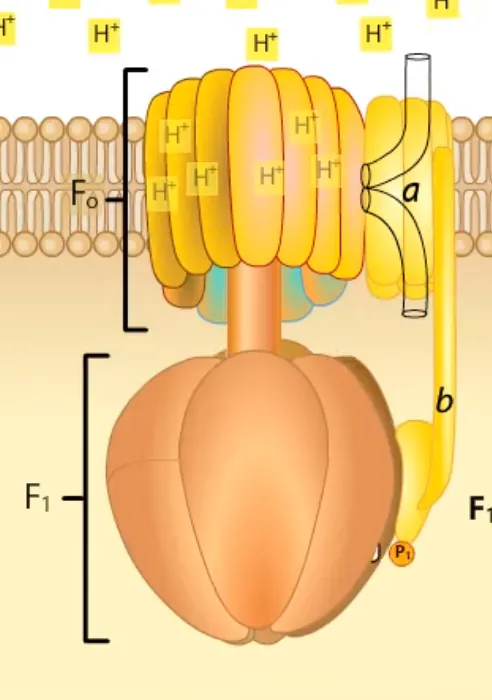
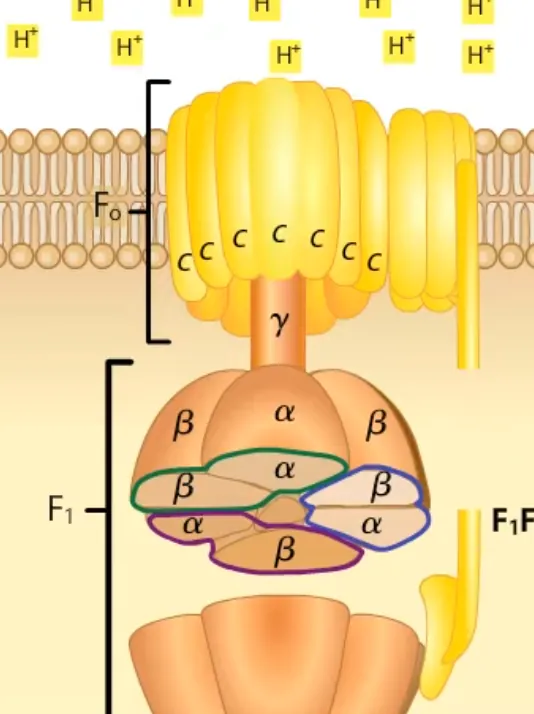
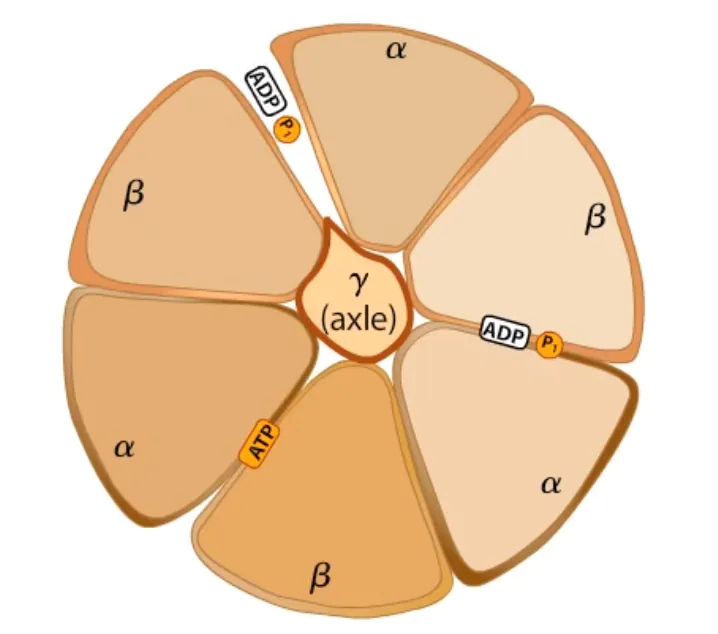
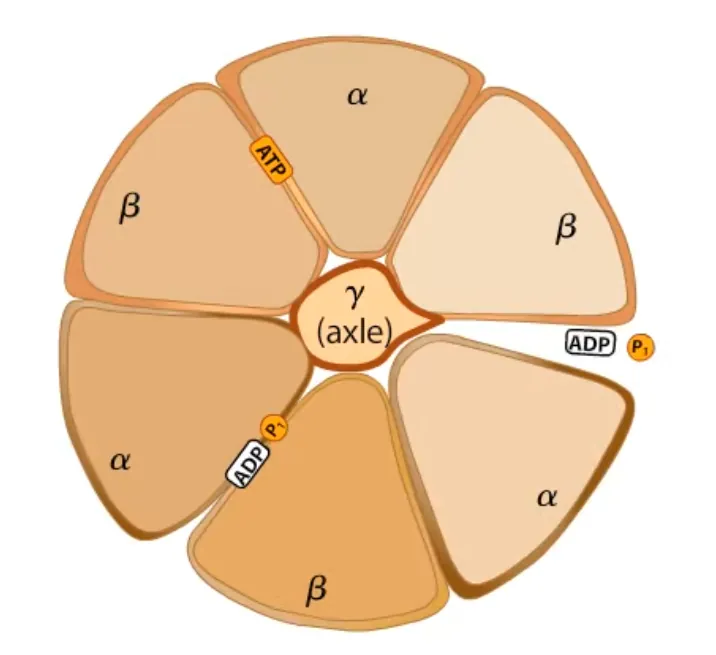
F1 regions has 6 units: 3 α units and 3 β units.
The γ axis rotates and interacts with different β subunits as it turns. During each 120° rotation of the γ subunit, it contacts a different β subunit
The three β subunits can exist in three forms:
O (open),
L (loose)
T (tight) forms.
In the O state, the β subunit is in a state where ADP and Pi can either bind to it or be released from it.
In the L state it traps ADP and Pi within its structure.
The T state of the β subunit is where the ATP synthesis occurs. In this conformation, ATP is synthesized from ADP and Pi without releasing the product. This ATP is released only when the T form shifts to the O form.
With each 360 degree rotation of the γ subunit, the β subunits shift through all three conformations, leading to the synthesis and release of 3 ATP.
2 electrons in the ETC cause 10 protons to be pumped to the Intermembrane space and generate 3 ATP via ATP synthase.
Hope you'll find this useful, if you have any questions feel free to ask in the comments!