
Glucose VS Fat

One of the clear demonstrations that Carbohydrates are the ultimate fuel for our cells, can be explained with the drug Meldonium(Mildronate)
In 1963 Phillip Randle discovered that fatty acids can block glucose oxidation, through a process called the Randle Cycle.
10 years later while the Soviet chemical industry was heavily focused on increasing agricultural and industrial efficiency. Ivars Kalviņš, Latvian chemist was searching for a chemical compound that could stimulate growth in plants and livestock, His goal was to identify a metabolic regulator that could signal cells to optimize their resources under environmental stress and produce more energy.
Ivars discovered that Meldonium blocks the formation of L-Carnitine,
A protein that delivers long fatty acids into the mitochondria, by blocking L-carnitine, fat oxidation is inhibited and the cell can oxidise glucose as the main fuel.
Ivars's research was focused on plants but later he decided that allowing cells to oxidise glucose might also support the metabolism of human cells, Ivars showed that during a heart attack (ischemia), Meldonium prevented the accumulation of acylcarnitine and acyl-CoA. These are toxic intermediate products of fatty acid metabolism that act like detergents, dissolving cell membranes. By blocking their production, Meldonium kept heart cells alive that would have otherwise died.
A few years passed by and the Soviet military became interested in Meldonium, and discovered that it inhances physical performance and started giving it to their soldiers, particularly those stationed in high-altitude, mountainous regions where oxygen levels were low, the drug was used to enhance physical endurance and protect the soldiers hearts from permanent damage caused by extreme physical exertion and oxygen deprivation under combat stress.
Our story gets a twist, During the 90s, Meldonium is getting sold over the counter in russia and ukraine, athletes began taking it as a regular supplement to boost their performance and to support their heart during intense training.
It was so effective that a random study in 2015 of over 8,000 athletes found that more than 2% were using it,a huge number for a substance that was still completely legal at the time. The big shift came from the World Anti-Doping Agency (WADA). In 2015, they started monitoring it closely, and by September of that year, after realizing it actually boosts performance and helps with recovery, they decided to ban it. On January 1, 2016, Meldonium was officially added to the prohibited list.
In clinical medicine, Meldonium is used to treat patients suffering from restricted blood flow and oxygen deprivation in various tissues. Doctors commonly prescribe it for Chronic Heart Failure and Angina Pectoris, as it significantly reduces chest pain and improves physical tolerance during exercise. Beyond cardiovascular issues, it's given to patients recovering from a Stroke or cerebral circulation disorders, helping to protect brain cells and restore cognitive functions. It has also proven effective in treating Chronic Alcoholism by mitigating withdrawal symptoms and stabilizing the metabolic system during recovery.
blocking fat oxidation and Increasing glucose oxidation, protects the heart and brain, Increases physical performance and helps to restore metabolism.
Meldonium is hard to find but here are some other options available cheaply worldwide: Avoid PUFA, eat a high carb diet, supplement with B1,B3, potassium, and Aspirin. All lower free fatty acids and increase glucose oxidation.
The Mechanism
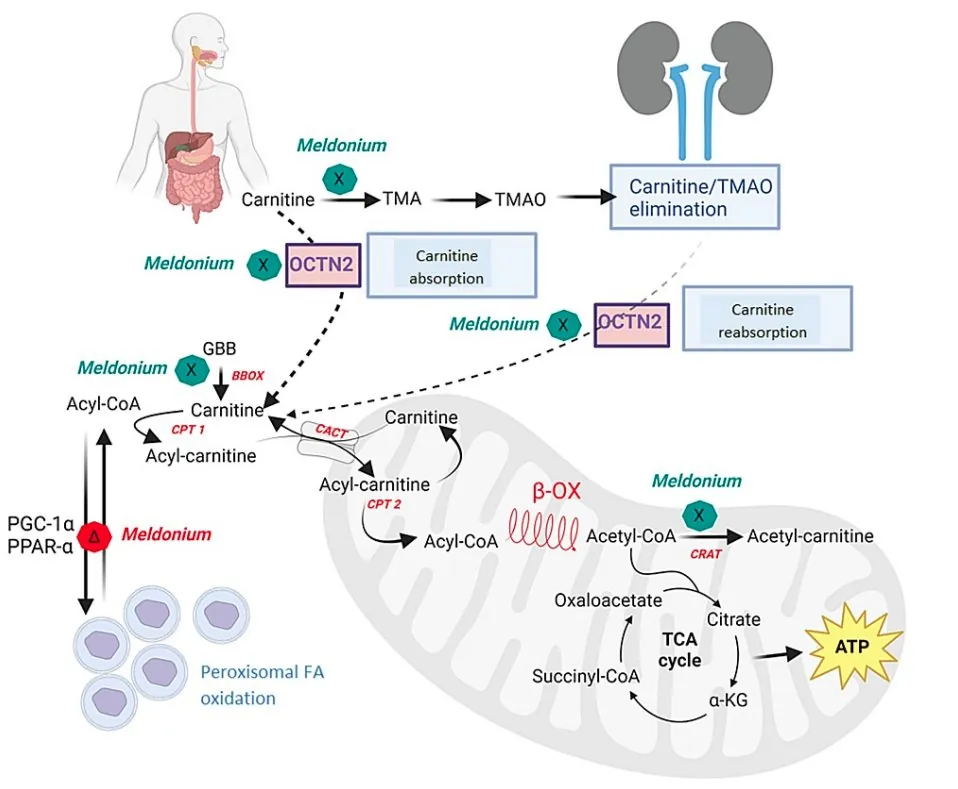
The enzyme called gamma-butyrobetaine dioxygenase, which is responsible for the final step of carnitine biosynthesis. By blocking it and lowering systemic carnitine levels, Meldonium limits the transport of long-chain fatty acids into the mitochondria. Since fatty acid oxidation is a highly oxygen-intensive process, shifting the cellular "fuel preference" toward glucose oxidation allows the cell to produce ATP more efficiently with less oxygen consumption.
Refrences
1. Hyperpolarized magnetic resonance shows that the anti‐ischemic drug meldonium leads to increased flux through pyruvate dehydrogenase in vivo resulting in improved post‐ischemic function in the diabetic heart
PMID: 33458907
2.Story behind meldonium-from pharmacology to performance enhancement: a narrative review
PMID: 27465696
3.Mildronate (Meldonium) in professional sports – monitoring doping control urine samples using hydrophilic interaction liquid chromatography high resolution/high accuracy mass spectromety
PMID: 25847280
4.Meldonium Ameliorates Hypoxia-Induced Lung Injury and Oxidative Stress by Regulating Platelet-Type Phosphofructokinase-Mediated Glycolysis
PMID: 35450040
5.Cardiocytoprotection with metabolic drugs - study of the effectiveness of meldonium in ischemic heart disease
doi.org/10.52645/MJHS.2022.3.06
6.Protective Effects of Meldonium in Experimental Models of Cardiovascular Complications with a Potential Application in COVID-19
PMID: 35008470
7.Meldonium Supplementation in Professional Athletes: Career Destroyer or Lifesaver?
PMID: 39092347
8.A dose-dependent improvement in exercise tolerance in patients with stable angina treated with mildronate: a clinical trial "MILSS I"
PMID: 22186118
9.Muscle carnitine availability plays a central role in regulating fuel metabolism in the rodent
PMID: 28605113
10. Unlocking the Potential of Meldonium: From Performance Enhancement to Therapeutic Insights, Val Bellman , Department of Psychiatry, University of Missouri Kansas City, Kansas City, MO 64108, USA
11. The use of mildronat with stenocardia patients
PMID: 2694612
12.Meldonium Improves Functional Capacity in Patients with Right Ventricular Failure
PMID: 41227182
13.Pharmaceutical Composition for Improving Physical Working Capacity
PMID: 26601841
14.Mildronate: cardioprotective action through carnitine-lowering effect
PMID: 12242052
15.Pharmacological effects of meldonium: Biochemical mechanisms and biomarkers of cardiometabolic activity
PMID: 26850121
16. Mildronate: An Antiischemic drug with multiple indications
PMID: 16007237