Hypothyrodism by Broda Barnes Part 1
In 1975 Broda Barnes wrote "Hypothyrodism the unsuspected illnes"
In his book he describes his experience as a doctor treating Thyroid Deficiencies, In this article i'll break down my favourites parts from the book.
The Thyroid Gland
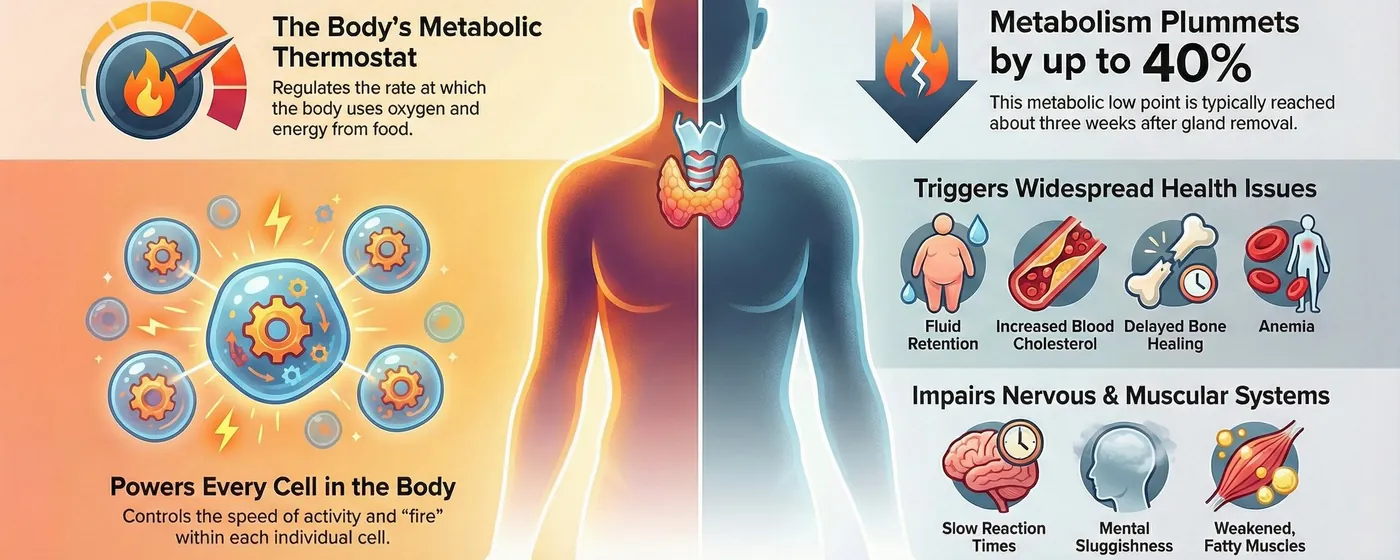
"lying in front of the throat below the Adam's apple and just above the breastbone, which regulates the rate at which the body utilizes oxygen and controls the rate at which various organs function and the speed with which the body utilizes food. In a way, the thyroid, through its hormone secretions, functions as a kind of thermostat. Each individual cell in the body is much like a microscopic power plant: it burns food and sets energy free, some of the energy being released as heat. Thyroid secretion is essential for the operation of the cell and, in effect, determines how hot the fire gets in the cell and the speed of activity in the cell. The term "metabolism" refers to the fires within body cells."
"When the thyroid gland is removed a normal animal, all metabolic activity is reduced. A decrease in heat production begins—in rabbits, for example, within five to seven days after the operation. By about the third week, metabolism reaches its lowest level, 35 to 40 percent below normal, a reduction corresponding to that seen in severe cases of hypothyroidism in humans."
"After removal of the thyroid gland, excess amounts of water, salts, and protein are retained within the body. Blood cholesterol also goes up."
"Healing of bone is delayed in thyroid deficiency. A rather severe anemia may develop in severe hypothyroidism. Thyroid hormone is essential for normal nervous system functioning and reaction time, and hypothyroidism may produce slow reactions and mental sluggishness. Muscle health too is dependent on thyroid secretion and with marked thyroid deficiency the muscles may become sluggish and infiltrated with fat"
Testing for Hypothroidism - Temperature and Pulse
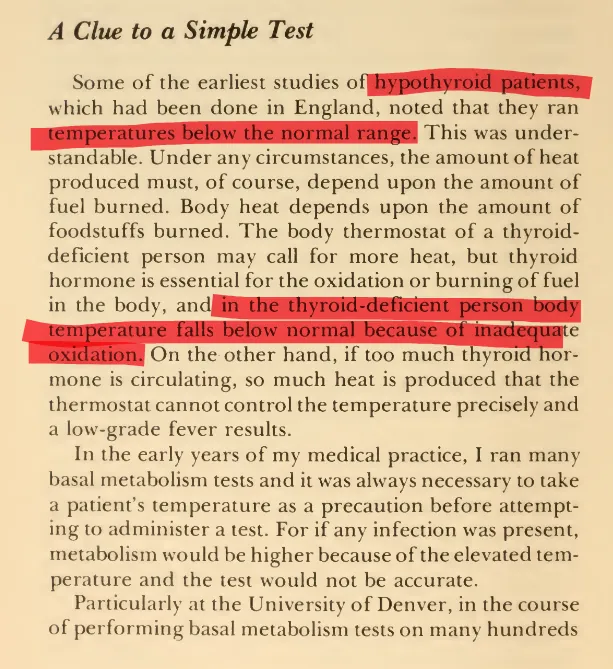
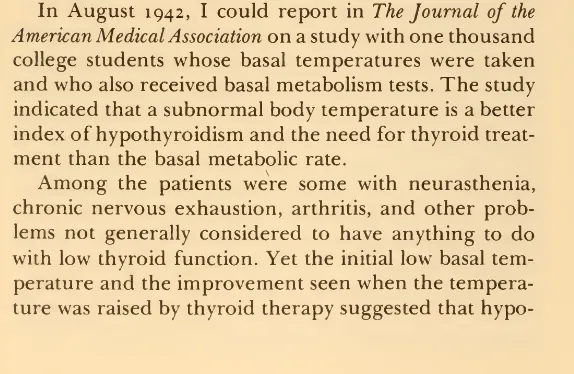
"For underarm temperature are in the range of 97.8 to 98.2 degrees Fahrenheit. A temperature below 97.8 indicated hypothyroidism; one above 98.2, hyperthyroidism. And, when thyroid therapy is indicated for low thyroid function, the simple test can be used to monitor the therapy. As low temperature rises with thyroid treatment, the symptoms associated with hypothyroidism will disappear. And there is no risk of excessive thyroid dosage as long as basal temperature does not exceed 98.2."
Symptoms and signs of Hypothroidism
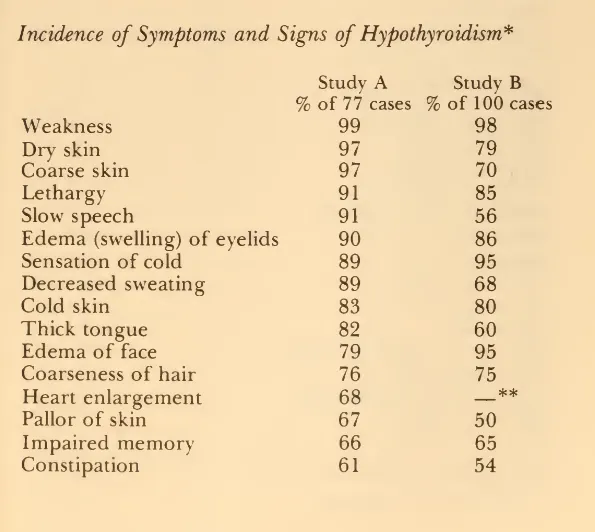
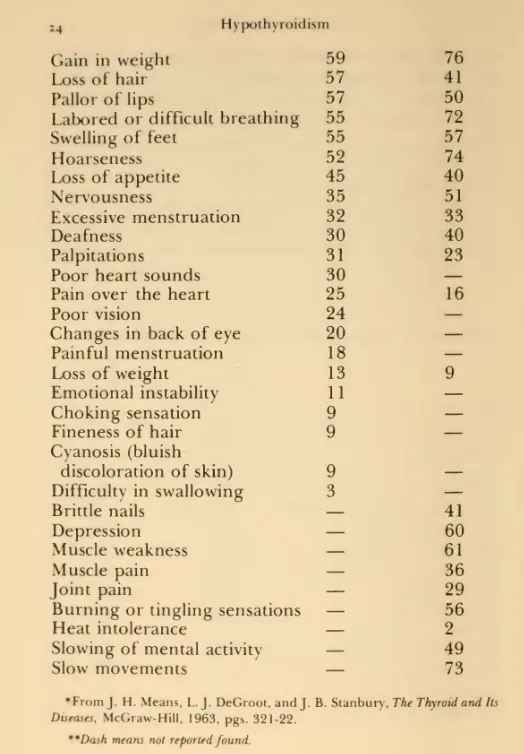
Hypothyroid statistics
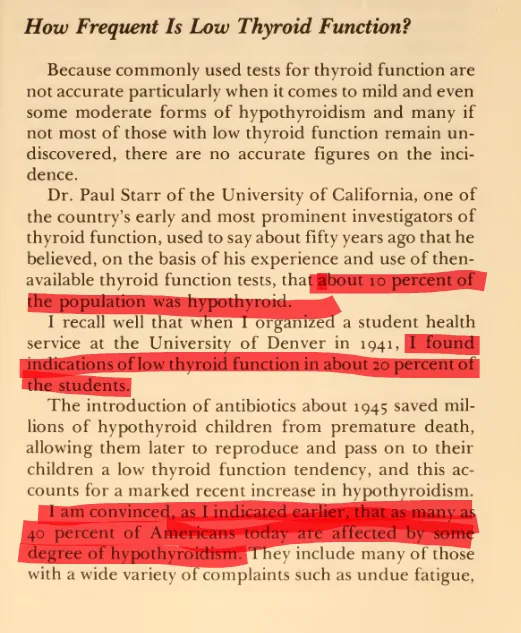
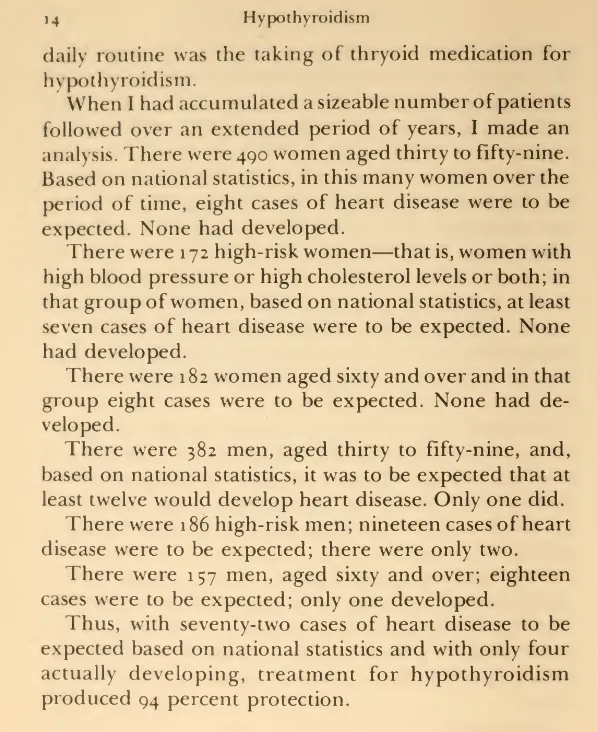
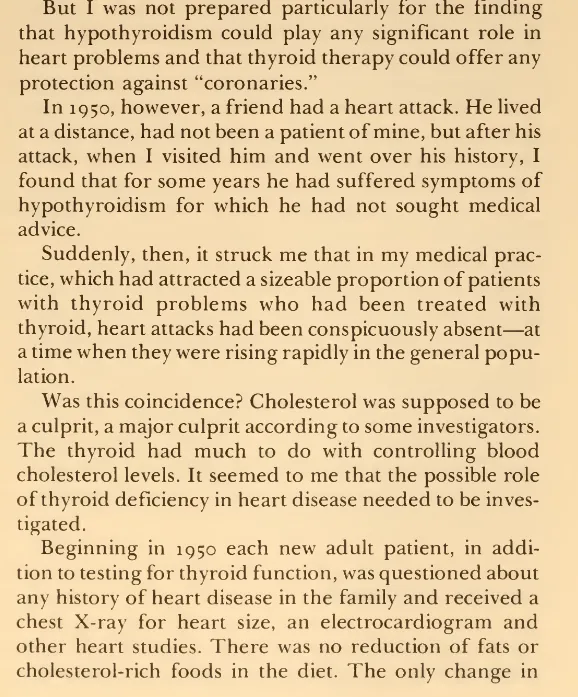
1.Thyroid and the Heart
2. Thyroid and intelligence
"There is an old medical saying that just a few grams of thyroid hormone can make the difference between an idiot and an Einstein. It aptly characterizes the thyroid's role as a quickener of the tempo of life"
3. Thyroid and the immune system
"thyroidectomized animals suffered repeated infections and died at less than half the normal age. When thyroid was administered to some of the rabbits, there was quick relief for their multiple problems and a seemingly miraculous return to health.(page 34)
4.Thyroid and blood cholesterol
5.Thyroid in the menstrual cycle
"It is highest shortly before the start of the menstrual flow and lowest at the time of ovulation."(p. 47)
"It is best to test the second and third days of the period after flow starts(p.48)
6.Thyroid and Fatigue
"A low energy level can take a mental and emotional as well as physical toll and can do so at any age."
"Fatigue is a normal result of intense physical exertion, emotional stress, or lack of rest. It is the body's signaling of a need to slow down, relax, get more sleep and rest. Fatigue that is not relieved by rest has another origin. It may be a symptom of any of a considerable number of possible problems"
A seventeen-year-old I saw recently had complained for years of being tired. He came from an excellent family of some means and he, like his brothers and sisters, was well provided for. But he could not function as did his siblings. Even after a prolonged night's sleep, he had difficulty getting up in the morning.He dropped out, tried work, but lost job after job because of lateness. He began to run with the wrong crowd, took to hard drugs, had an encounter with the law. Fortunately, in the sense of better late rather than never, his fatigue (and the effects of it) were found to be associated with a subnormal basal temperature and within three months after therapy was begun he was enrolled in a rehabilitation program and in school again, very much interested now in trying, and better able to make something of his life."
"Her major complaint was fatigue. For much of her life, she told me, she had felt that she lacked ordinary pep. She had gotten along fairly well in her younger years but it had seemed to her that she had had to push herself hard to overcome a kind of inertia that stemmed from lack of a normal amount of energy. She had always needed nine or ten hours of sleep. She was a heavy coffee drinker, using it to try to pep herself up.
"When I saw her, she had come armed with the clinic and hospital records and with a temperature record. She had taken her basal temperature at home a dozen times. It was consistently low. She was started on a small dose of thyroid. It was increased gradually until her basal temperature rose. As it did so, her abnormal fatigue disappeared. There is nothing at all unusual about her case. A low energy level with easy fatigability can have other causes, certainly. It is, however, a common problem of the hypothyroid and has long been known to be. Some studies have shown it to be a major complaint in as many as 98 percent of all patients found to be hypothyroid by basal metabolism, PBI, and other standard tests.(p.52)
7.Thyroid and anemia
"Red blood cells are manufactured in the bone marrow, the soft, spongelike material in the cavities of bones. A study had been done on the effect of the temperature of the bone marrow on the formation of red cells. It had long been known that marrow differs at different sites in bone. In bone in the upper part of the arms and legs, the marrow is red and forms blood cells, but in the lower reaches of the extremities, the marrow color is white and no blood is formed.(p.59)
"The hypothyroid patient may experience effects like those produced by anemia, including undue fatigue, for another reason. Thyroid deficiency tends to reduce the strength of the heartbeat, and the amount of blood pumped out to the body with each beat is reduced.(p.60)
8. Thyroid and Migraines/Headaches
"I shared an office in Chicago with a physician who suffered from migraine headaches. when he became overly excited about anything else, or unduly tired, he would develop a severe headache. His migraine attacks were coming more and more often and their severity was increasing. One day, I got up nerve enough to corner him and insist that something must be done about the headaches, I took his temperature and found it low. His pulse rate also was low: 44. I examined him thoroughly and drew blood for laboratory tests. The tests revealed nothing, no abnormality. The low temperature and the low pulse rate indicated low thyroid function and I suggested that we should certainly do something about that. He agreed to thyroid therapy but had no faith that this would do anything for his headaches. Xor, in fact, did I at the time. Yet, within a few weeks, both of us were agreeably surprised. Even as he began to feel less tired as the result of the thyroid therapy, his headaches began to diminish in intensity and frequency. Over a period of several months, as he became increasingly vigorous, his migraine attacks diminished almost to the vanishing point"(p.63-64)
"I also became aware as I worked with migraine patients that fatigue seemed to play an important role in initiating their attacks. Almost invariably, migraine victims, upon reflection, would indicate that their attacks came on when they were very tired. They also indicated, when questioned, that as their attacks came on, they often had to loosen their shoelaces because they felt their shoes becoming tight.
Barnes also tested college students with migraines
9. Thyroid in Emotional and Behavioral problems
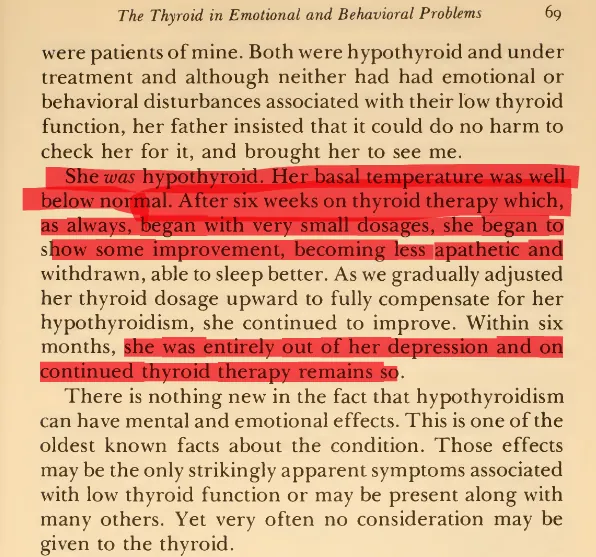
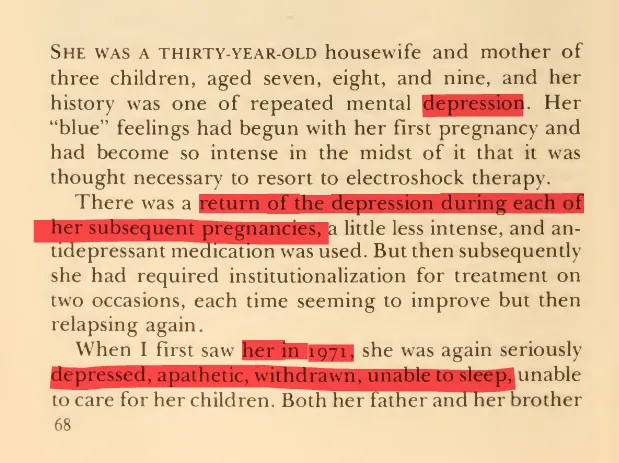
Depression eliminated by thyroid therapy.
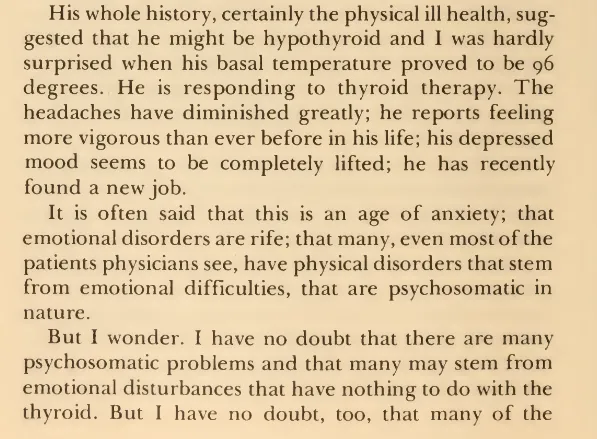
Another case of 30 year old male with migraines and depression
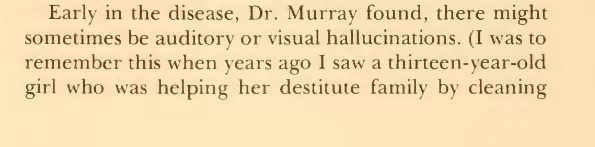
Other girl suffered from hallucinations, fixed on thyroid therapy.
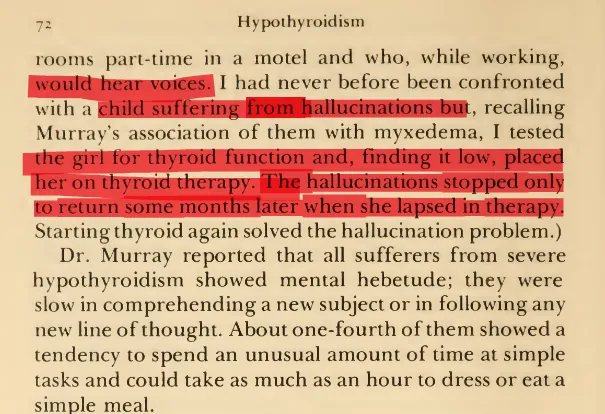
Other male has fearful suspicion of others.
"had become suspicious that everyone was trying to poison him. He refused to eat. Fortunately, he was thoroughly studied, found to have hypothyroidism, and his psychiatric problems disappeared completely on thyroid therapy. He was returned to duty and functioned well"(p.72)
Other kid suffered from nightmares
"I recall a ten-year-old boy who began to experience nightmarish dreams and would scream for long periods before his parents could get him awake enough to reassure him that he was only having a dream. The terrifying dreams kept increasing in frequency until they were occurring almost nightly and sometimes several times a night. The only definite physical finding in the child was a subnormal basal temperature. On thyroid therapy, the dreams ceased. As mentioned previously, one of the remarkable features of hypothyroidism is that it may produce seemingly paradoxical effects—both physically and mentally. "
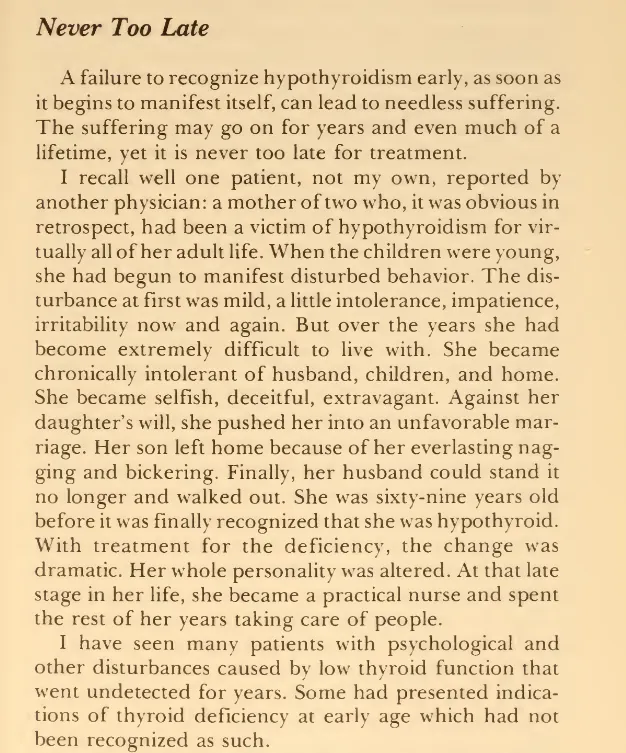
Other women had a whole shift in personality
10.Thyroid and Infectious Diseases
In graduate school, as I've indicated earlier, I worked with baby rabbits whose thyroid glands were removed in order to demonstrate the important functions of the thyroid by noting what were the consequences of its loss. And not least among the many consequences were con- tinuous sniffles, repeated acute infections, and death at an early age of pneumonia. Yet it wasn't until five years after I had completed medical school that I realized why I might be so prone to infections. I was giving a series of lectures on endocrinology at Stevens College in Columbia, Missouri. The time Was early October. The evenings seemed quite cool, even cold, to me and I wore a topcoat. I noticed, however, that other faculty members and the students seemed to have no need for topcoats and appeared perfectly comfortable without them. I remembered then that a common complaint among hypothyroid patients in my practice was a tendency to feel cold even in what for others was a pleasantly warm room. Suddenly the thought struck and I told myself: "You fool, you're one of them." I had begun to use basal temperature as a means of detecting low thyroid function. I took my own. It was low. Lifelong medication with thyroid began immediately thereafter, and I have had little further trouble from infections.

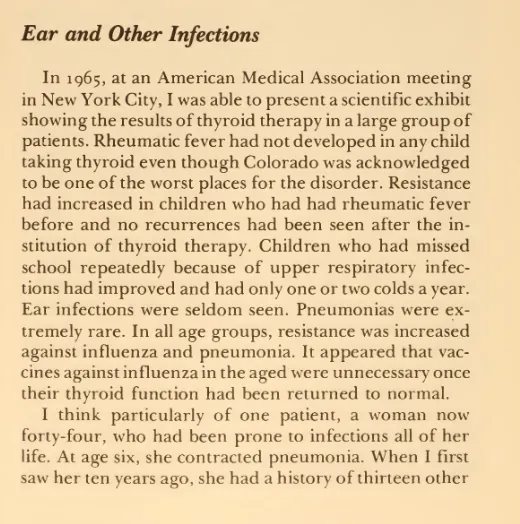
"My first medical report on the thyroid and infection was made in 1953 after I had followed for some time a group of 150 patients who had been susceptible to respiratory infections and had received thyroid therapy for low thyroid function. They not only felt more vigorous and in better general health but they experienced far fewer infections. Since then, I have seen the same gratifying results in many hundreds of others. For some, the primary com- plaint that brought them to treatment was repeated infection; for others, proneness to infection was one of a number of symptoms of hypothyroidism. No matter. Once the hypothyroidism was corrected, there was increased resistance to infectious disease."(p.92)
In my experience, resistance to bladder and kidney disease in patients with low thyroid function can be increased greatly and readily with thyroid therapy.(p.97)
"One young patient, a boy who broke his foot in a bicycle accident, developed osteomyelitis which would seem to yield for a time to antibiotics but kept recurring. Not until he was found to be hypothyroid and was placed on thyroid therapy did the infection really subside and healing take place."(p.97-98)
"When low thyroid function is responsible for lowered resistance to infectious disease, about two months of treatment are usually needed to raise the resistance. The effect will wear off in six months to a year if thyroid therapy is stopped.(p.99)
11. Thyroid and the skin
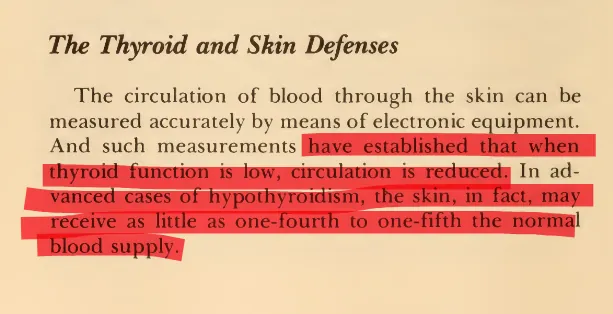
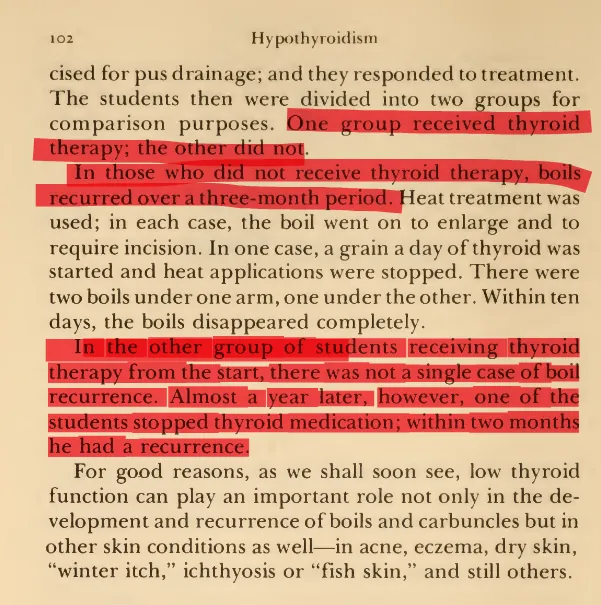
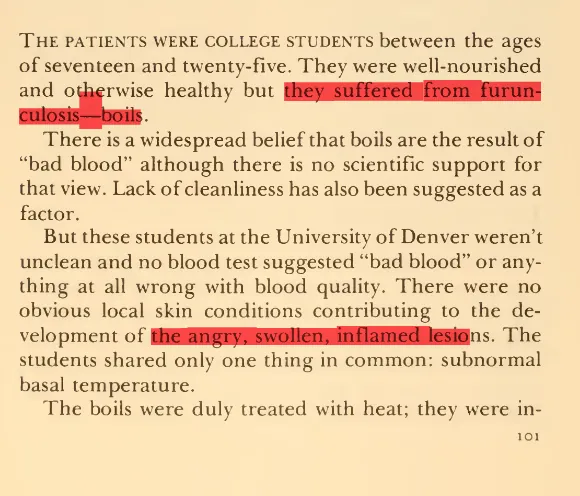
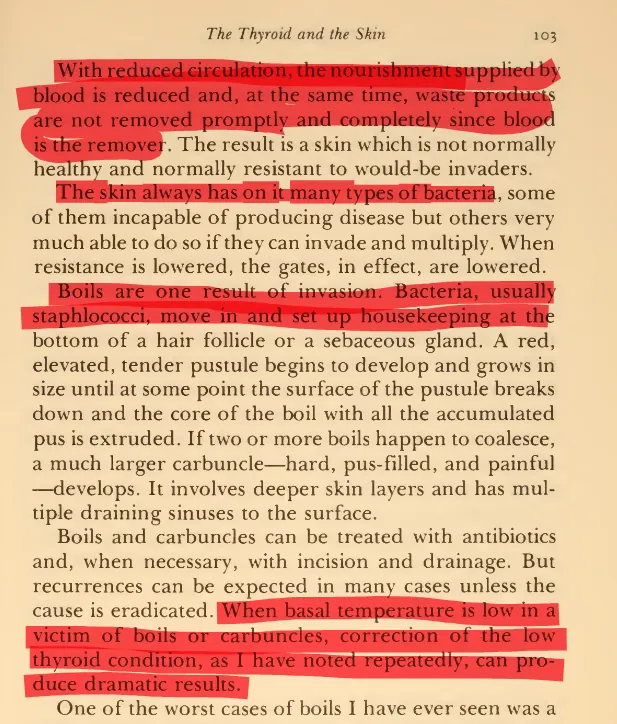
"I saw many students with acne. About that time. Dr. R.L. Sutton, Jr., a well-known Kan- sas City dermatologist, published a medical report telling of good results in the treatment of acne with use of three measures: thyroid therapy, dietary changes, and local treatment. When I saw his report, I wondered which of the three measures might be the most effective. Could it be the thyroid regimen? Dietary changes and local treat- ment had been tried many times before without any remarkable effect. I worked with a group of students with acne, foregoing local treatment and dietary changes. The only measure used was thyroid therapy. The results with thyroid therapy alone matched those obtained by Dr. Sutton with the three-measure regimen. The majority of students showed marked improvement; a few did not. Ever since, in every case of acne, I have checked for thyroid function and where it has been low as indicated by basal temperature I have prescribed thyroid,more than 90 percent of patients have benefited to some degree, and often to a marked degree.."(P.106)
"One of my oldest patients with the problem was a sixty-one-year-old man, When he removed his shirt for the electrocardiogram, I noted that his back was covered with acne lesions. He had had the problem, he told me, ever since his teens and nothing had ever been found to help, the dose was minimal half a grain a day. Gradually, we could increase it to what was needed, two grains a day. Within a few months his acne had cleared entirely and has not returned."(p.107)
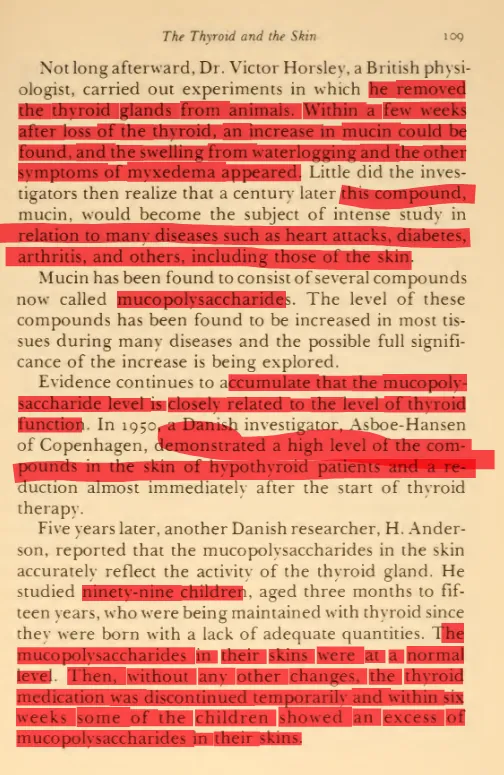
"Some of the most dramatic successes of thyroid therapy have been in eczema, which involves itching, swelling, blistering, oozing, and scaling of the skin."(p.112)
"In 1896, a British physician was one of the first to report the disappearance of eczema during thyroid ad- ministration in a sixty-five-year-old woman. In his report, the physician noted that if thyroid treatment was stopped, the eczema reappeared, but when thyroid therapy was resumed again, the eczema disappeared again.(p.113)
"In one case, the improvement was spectacular. This was the University of Denver retired dean whom I mentioned earlier. After half a century of being plagued by psoriasis, his skin cleared entirely with thyroid therapy.(p.117)
12. Thyroid in Menstrual disorders and Fertility
"The normal woman begins her periods at about the age of twelve or thirteen, flows for four or five days, suffers no cramps, and repeats the cycle every twenty-six to thirty days. She should be able to become pregnant when she wishes to, go through nine months of gestation with little more than occasional discomfort, and should be able to deliver a healthy baby"(p.121)
"When A THIRTY-THREE-YEAR-OLD WOMAN presented herself for examination at a major clinic, she had noted an increase in the amount, duration, and frequency of menstrual flow, she had received eight additional blood transfusions. With the last two, she had developed hives, chills, fever, and symptoms of asthma. A test of thyroid function showed clear-cut hypothyroidism. Two months after she was placed on one and a half grains of thyroid daily, her menses returned to normal and all her other symptoms disappeared."
"leading gynecologists in this country and else where were reporting that thyroid had cured more menstrual disorders than all other medications combined"(p.120)
"Among patients known to me personally, the youngest at onset of menses was eight. Her thyroid deficiency was not recognized until the age of twenty-two when I saw her for problems other than menstrual difficulties alone. Her history revealed that after her first period occur- red at the age of eight, she skipped three months but then continued to have periods at irregular intervals there after. All through her childhood and adolescence, she displayed other indications of thyroid deficiency: repeated respiratory infections, fatigue, frequent headaches. These symptoms responded to thyroid therapy.(p.122)
"On thyroid therapy, more than 90 percent of those with painful menstruation were relieved, most of them completely. The results were fully as good in converting irregular periods to normal, regular ones. And in six of seven women with excessive menstrual flow, normal flow was established."
"Forty-eight of the women suffered from menstrual cramps. Only five failed to get some relief from thyroid therapy; thirty-five experienced complete relief. Forty-five of the women had irregular cycles. Fortythree benefited, with the cycles becoming completely regular in forty-one.
Thyroid needs Iodine
"The thyroid gland is the principal user of iodine in the body. In a normal person, dietary iodine is absorbed from the gut into the blood and then, in the thyroid, is removed from the blood, "trapped" in the gland, and incorporated there into compounds which in turn are assembled into thyroid hormone secretions." when a small cocktail containing radioactive iodine is swallowed, the iodine tends to be attracted to the thyroid gland,"(page 41)