The living State
In this article
My favorite quotes and my own take on the book "The living State" by ALBERT SZENT-GYORGY.
:
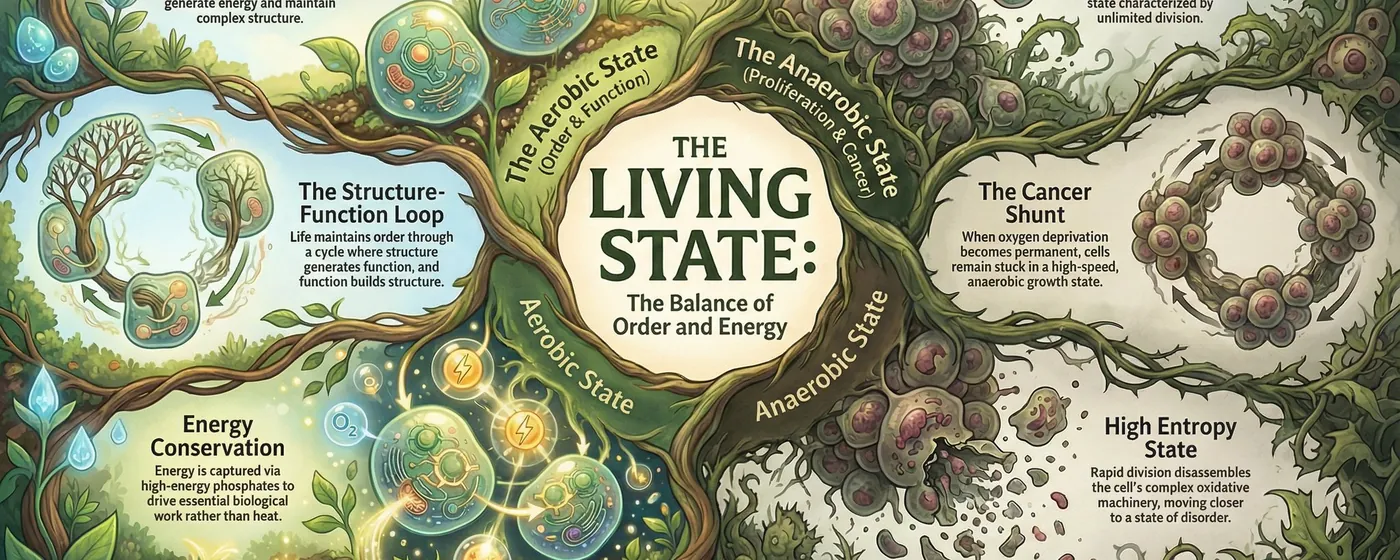
The book explores the question "What is life?" by defining it as a revolt against entropy, where life is made possible by order, structure, and patterns developed over billions of years and how is "water dancing to the tune of solids"
Chapter 1
"Nature answers intelligent questions intelligently; so if no answer exists, there must be something wrong with the question"
"What are the properties which bring matter to life?
Entropy is a fundamental concept that measures the level of disorder, randomness, or chaos within a system.
The Second Law of Thermodynamics states that the total entropy of an isolated system always rises.
Gyorgy writes "Life is made possible by order, structure, a pattern, which is the opposite of entropy. This pattern is our chief possession, it was developed over billions of years. The main aim of our individual existence is conservation and transmission of energy. Pattern and structure can turn things around. As a rule, opposite charges approach, neutralize one another, and produce motion. Life took its own course when its first pattern was established. Life is a revolt against the statistical rules of physics. Death means that the revolt subsided and statistical laws resumed their sway"
"life rests on three pillars. One is the decrease of activation energy, accomplished by enzymes. The second is the conservation of the energy liberated and its investment in new reactions. This is done by means of the "high energy phosphates," ~ P ' s . The third is photosynthesis, by means of which life uses the radiation energy of the sun to build new molecules from which energy can be liberate"
" If I were to ask a physicist what the probability was that the trillions of electrons and atomic nuclei would get together and stay in the relative position they are in me, the answer would be that the probability was practically zero"
"If we ask Nature "Is light a particle?" Nature will answer "Yes, it is a particle." But if we ask "Is it a wave?" Nature will answer "It is a wave"
"system can only do what its structure allows it to do So structure and function are, in a way, identical. Structure generates function, function generates structure"
" Life has developed its processes gradually, never rejecting what it has built, but building over what has already taken place. As a result,the cell resembles the site of an archeological excavation"
"The older a process, the more basic a role it plays and the stronger it will be anchor"
"I went from animals to cells, from cells to bacteria, from bacteria to molecules, from molecules to electrons. The story had its irony, for molecules and electrons have no life at all"
Chapter 2 - Water, The hub of Life
"Life is water dancing to the tune of solids"
"Life originated in the ocean. Water is its mater and matrix, mother and medium. Life could leave the ocean when it learned to grow a skin and take the water with it. We are still water animals, only we have the water inside, not outside."
"This queer, four-legged creature has a bend in the middle. Two of its legs are formed by its two H's, which give to their half of the molecule a positive charge enabling it to act as H donor forming two hydrogen bonds with other water molecules. The other two legs are formed by the nonbonded electron pairs of oxygen which lend to this end a negative charge, making the molecule a strong dipole, with a tetrahedral shape, enabling it to form two H bonds as acceptor with two other water molecules or whatever H donors there may be. The water molecule is thus capable of forming four H bonds of considerable strength of about 6 calories each. Each water molecule can thus bind four water molecules, each of which, in turn, can also bind four molecules. This entails that below 0°C water as a whole turns into one single continuous solids"
"we usually find a breaking point around 15°C, another around 45°C, and one in between, around 30°C (Drost-Hansen, 1956—1966). It seems likely that it is these breaking points which set the limits of life for warm- blooded organisms. If our body cools below 15°C, death ensues. Our normal body temperature may be 37°C because Nature not only wants to enjoy the advantages of heat agitation but also wants to keep at a safe distance from 45°C. If our temperature, in an infection, rises to 42°C, it is time to call the undertaker"
"The unique physical state of living tissues may be due, to a great extent, to water bonds. My skin is very tough; with a little tanning it would make good boots. At the same time, it is also soft and pliable. This indicates that the system is held together by a great number of weak bonds, easily formed and broke"
"The water bond is a weak one, but many weak bonds are just as strong as a few strong ones"
Chapter 3 - Motion And Muscle
"Most signs of life are energy transductions, transduction of chemical energy into some sort of work, mechanical, electrical, or osmotic, the products being motion, reflexes, or secretions. Of these products motion is the oldest, the most obvious, and apparently the simplest. "
"myosin can act as ATPase, splitting off ATP's terminal phosphate, but a very poor ATPase, its enzymic activity was greatly increased by actin. One protein could thus change the enzymic properties of another, Actin and myosinformed a highly viscous complex we called "actomyosin." We could also show that resting muscle contained no actomyosin, but behaved as if it contained only actin and myosin side by side. It was only during an excitation, in the "active state," that actomyosin was formed. This is why, at rest, muscle is soft and does not split its ATP"
"The most striking property of actomyosin was its enormous affinity for water, its strong hydration. I never succeeded in making a stronger actomyosin solution than 3%, containing 97% water, muscle contraction is essentially a play of water"
" in addition to actin and myosin muscle contains a third fibrous protein, tropo-myosin. This tropomyosin is attached to actin alongside. The thin "actin filaments" of muscle actually are actin-tropomyosin fibers, troponin has a great affinity for Ca 2+, . What excitation does is to liberate C a 2 + from the "sarco-plasmic reticulum." This C a 2 +, then, is bound by thetroponin, neutralizes its negative charge, and abolishes herewith its repellant action toward the HM head"
"Muscle has three functional states: the relaxed, the activated, and the contracted."
"Relaxed state. In this state the muscle is soft "
"Activation The C a 2 + released by the sarcoplasmic reticulum was bound by the troponin, neutralized its repulsion toward the H globules which became attached to the thin actin-tropomyosin-troponin thread":
"Contraction The globule of the H meromyosin, having been enzymically activated by its interaction with actin, has split the ATP attached to it, while the stalk dehydrated and contracted"
"In contraction the ATP (adenosine triphosphate) is dephosphorylated to ADP (adenosine diphosphate). The ADP is rephosphorylated t o ATP by a very powerful enzyme, phosphoferase, which transfers the phosphate of creatine phosphate onto it."
"In hydration and dehydration, as well as in the generation of waves, Κ and Na ions may also be involved. The contraction of actomyosin is limited to a narrow range of the concentration of these ions and, according to Ling (1962), the Κ ions in tissues are not free but are bound to protein. So a change in their concentration or binding may be involved in building water structure"
Chapter 4 : Biological Stability
"A virus infection is essentially the introduction of a foreign pattern"
"The human pattern is preserved chiefly in nucleic acid, and is transferred from generation to generation in DNA. Evolution is, essentially, a gradual change in this pattern that occurs through molecular accidents"
": inanimate machinery gets worn out by use, while live machinery improves by use and is impaired by inactivity. If you use your car too much it becomes worn out, while if you walk your legs become stronger"
The staircase effect
"In 1871, Henry Bowditch, a young American working in Ludwig's laboratory (1871), described a simple experiment, He He disabled a frog's heart, making it dependent on electric stimulation. Then he stopped stimulation for a little while, probably expecting to find the first beats after the pause stronger. What he found was the opposite: the first beat after the pause was weaker, the weaker the longer the pause. The second beat was some what better, each successive beat being somewhat stronger than the previous one, the peaks on his tracing rising as a staircase. This phenomenon, accordingly, is called "the staircase." What does this mean? It means that function generates function, motion generates motion, life generates life, while inactivity begets inactivity, makes motion and life fade away"
"We found that during the pause potassium was accumulated in the fibers; this is why the heart became weak. When the heart was allowed to beat, the potassium was pumped out again, order was restored"
"The more life does, the more life it is; the more negative entropy is liberated, the more can be retained of it. Life supports life, function builds structure, and structure produces function. Once the function ceases the structure collapse"
"Adaptation and development involve not only the creation of something new, but also the discarding of what has become useless. Occasionally this may also lead to trouble. If cell cultures are intermittently deprived of oxygen they adapt to the new situation and shunt back to the anaerobic proliferative state, discarding the mechanism of biological oxidation. If this change becomes "constitutive," the cells will be unable to return to the aerobic way of living and cancer develops"
Chapter 5
"A molecule is, essentially, a cloud of electrons, held together by nuclei, and so its energy can be no other than electronic energy. Strictly speaking, an electron, in itself, has no energy, as water has no energy. Water can give off energy and drive machines when it drops from a higher to a lower level, say from the top to the bottom of Niagara Falls. Similarly, the electron can give off energy and drive the living machine by dropping from a higher to a lower energy level. A high energy level means that the electron is held loosely (has a low ionization potential) and can drop to a lower energy level (of high ionization potential). At the lower level, it will be held more strongly, that is, more energy will be needed to lift it to a higher level or detach it from the molecule altogether. "
The table of elements
"Mendeleef has ordered the elements into a single system, the elements on the left side of the table would have to give off electrons while those on the right side of the table would have to take up electrons. Li, for instance, would have to give off one of its three electrons to have two, as He has, while F would have to take up one electron to have ten as Ne has. This make the elements on the left side positive, those on the right side negative. Elements on the left side will tend to donate electrons while those on the right will tend to accept them"
Hydrogen
" H, from the left, will be able to give off its electron and release energy by interacting with 0 , an element from the right. In this interaction water will be produced and the electron of H will go from its high level to a lower level in H 2 0 , releasing the difference in energy. To put this into common language: by burning, oxidizing H, we can produce water and energy. At present, the energetics of the biosphere is based on this one reaction, the interaction of H and O, the separation and reunion of the two. The energy needed for the separation is supplied by light (photosynthesis), while the energy released in the reunion drives life (biological oxidation)"
"A glance at the atomic table shows the exceptional nature of H. It forms a group by itself. No other element has similar properties. Being the smallest, it is also the most mobile of atoms. It consists of an electron and a proton. A proton could not hold two electrons, but could easily part with its own. So we can say that, in a way, H is a package of energy which only has to interact with an atom (or atomic group) from the right side of the table to release its energy. Attaching H to a molecule means lending energy to it. Since in H the electron and proton are loosely coupled, by attaching an H we essentially attach an electron. So the chemists look upon both processes, attaching an H or attaching an electron, as more or less identical processes, and call it "reduction." Detaching oxygen is also a "reduction." The opposite of reduction is "oxidation". which is detaching H, or electrons, or adding oxygen. By reducing a molecule we increase its energy, by oxidizing it we decrease it"
"if a molecule, say a sulfer atom, acquires an electron and becomes S", this S" can easily pick up a proton from the water and become SH"
This happens because molecules prefer to be in a neutral state, without any electrical charge. If a molecule receives only an electron, it becomes negative so it will look to attach Proton to become neutral.
" The living
systems take these H's off and replace them with water.
The foostuff is essentially an H donor while 0 2 is an
"H acceptor." H is the fuel of life. When life originated, there was no 0 2 in the atmosphere, so the first primitive living systems had to use some other H acceptor, and their metabolism had to consist of simply taking H's from foodstuff, liberating and using their energy by attaching them to the acceptor they could find. The only complication was that one can feed only when there is food, while life demands energy all the time. So the energy has to be stored. We solve this problem by storing food in the form of fat or carbohydrates. The first primitive living structures could not afford such a complex method and simply had to store the H's or electrons as such"
Dehydrogenation, having been one of the earliest biological processes, is still the foundation of our metabolism, and the dehydrogenases belong to our most important enzyme"
" These primitive organisms must have had many things in common with present-day anerobic bacteria"
The origin of life
"The structure of the energy-producing metabolic apparatus reflects the history of life. When life originated there was no light and no oxygen, the light being absorbed by a heavy layer of water vapor. In this first anaerobic period, life energy production must have been based chiefly on the possibility of taking H's or electrons from foodstuff, while the continuity of life was safeguarded by the ability of unlimited proliferation. Fermentation, essentially, consists of taking off andattaching H, reshuffling structure. It is linked to unlimited proliferation and anaerobic energy production. As the earth cooled and the water vapor condensed, long wavelength red light could get through. To catch it,life developed a green dye, chlorophyll, green meaning that red is absorbed. The energy of these photons sufficed to separate the H from the Ο of water. This invested energy could be regained by reversing the process, attaching Η to 0 , that is using 0 as the final electron acceptor and "burning" the H. Probably, the energy of the Η was, at first, directly converted into the energy of ~P's, Later, a bulkier and more efficient and complex oxidative machinery was developed which, being the last addition to the energy producing mechanisms, is also most easily dispensed with. So when the cell divides it disassembles, partly or wholly, this oxidative mechanism and reverts to the simple and older anaerobic methods of Η pooling and fermentation as has been shown by the classic work of Warburg (1966). Cell division and anaerobiosis are coupled."
The Sulfur System(S-H)
"In the cell there are two kinds of sulfhydryl groups, SH "fixed" and SH "soluble." The fixed ones were bound to the cellular structure while the soluble ones were part of a polypeptide, gluthathion"
When oxidized, the SH's lose their Η and the S's join to form S~S, disulfide, H, in protein solutions, can "jump" from one S to another."
"when the cell divides it has to break down its bulky oxidative mechanism and revert to the more archaic fermentative method of energy production and the use of the H pool"
Chapter 6 - Vegetable defense systems
If we expose ourselves unprotected to sunshine we get a sunburn; our skin becomes damaged. The damage activates the tyrosinase system; the tyrosinase oxidizes tyrosine into a black pigment which then protects us against the sunshine. This cycle of events reflects the basic principle of defense: the cell contains an enzymic system which becomes activated by the damage and then protects against the damage"
"There is but one life on earth. We are all but recent leaves of the same old tree of life. There is no basic difference between the grass and the man who mows it. Life has differentiated to a great extent. There are many major differences between plants andanimals.
One is that plant cells have a solid cellulose membrane. While this membrane is intact, the cell is inaccessible to bacteria and needs no protection against them. Plants have no blood circulation, but animals have; the latter can thus mobilize the defense of the whole body against a local lesion, while plants have to deal with it locally. This makes it difficult for plants to repair damaged cells. The damaged cells thus have to be eliminated altogether to prevent serving as food for bacteria"
" Plants defend themselves against bacteria by regulating their proliferation, Proliferation is a basic attribute of life involving all parts of the cell, and can best be regulated by changing one of its basic parameters. A dividing cell needs energy, so proliferation can be arrested by withholding energy, energy means H or active electrons, i.e., H or electron donors; it means a reducing atmosphere. So growth can be prevented by an oxidizing atmosphere, Growth can thus be arrested by changing the D/A (Donor/Acceptor) quotient in favor of A. The stronger the acceptor the more powerful its action will be" this makes Quinone molecules a strong anti bacterial agents.
"There is but one acceptor which the cell can readily produce: the double bond. One of the two bonds of a double bond is a σ bond, the same kind of bond which holds most organic molecules together. The other is a π bond. Each double bond has two π orbitals, usually only one of which is occupied by electrons, the one with the lower energy"
"A small electronic system, such as a double bond, is not apt to accept an unbalanced extra electron which upsets its electroneutrality. This makes it a very poor acceptor. We can extend the system and make it a better acceptor by adding a second double bond to it in the α-β position. The two double bonds, being separated by one saturated C-C bond only, are "conjugated," and their π systems fuse"
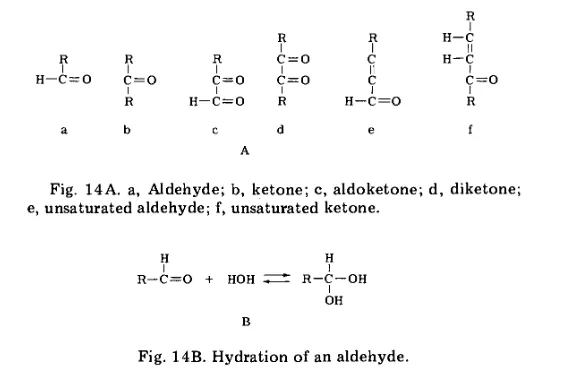
If the C=0 is located at the end of a carbon chain, the resulting substance is an aldehyde , Ketones are thermodynamically satis- factory as acceptors but are not very reactive. Aldehydes are more reactive but thermodynamically less favorable, being hydrated"
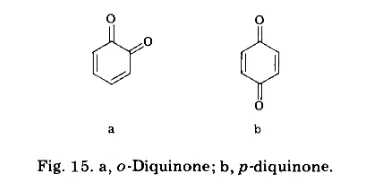
The most active acceptors can be formed by placing two C=0's side by side on an aromatic ring which, in itself, is a system of conjugated double bonds. The resulting substance is an o-diquinone (Fig. 15a). The p-diquinone (Fig. 15b) is somewhat less active, the two O's being separated, though still connected by the conjugated bonds of the aromatic structure. These quinoid acceptors are most powerful, and Nature uses them chiefly with the intent to kill"
THE POLYPHENOL OXIDASE SYSTE
"Fruits and vegetables can be divided, grossly, into two groups: those which discolor, become brown or black on damage, and those which do not. If you drop a banana, apple, or pear, the next day you will find a brown patch where the fruit was damaged. If you peel potatoes, or work with mushrooms, your hands get black.
Lemons, oranges, watercress, and cabbage never discolor.
The first group characterized by the presence of a polyphenol and a polyphenol oxidase. called polyphenol oxidase plants The plants which show no such discoloration are characterized by the absence of a polyphenol oxidase and the presence of an active peroxidase. called peroxidase plants.
Polyphenol oxidase plants turn brown or black upon injury, as seen in bananas and potatoes. The defense structure in these plants is triggered by cellular damage, which increases entropy and activates the enzyme to oxidize polyphenols into highly reactive o-diquinones. These quinones function as potent oxidizing agents that destroy invading bacteria and they tan the plant's proteins to create a protective, antibiotic shield over the damaged tissue.
""This enzymic system has a high survival value. It is a most ingenious trap set for bacteria which penetrate the cell, hoping for a good feed: by damaging the cells they activate the enzyme and therefore commit suicide. The Creator must have had much fun thinking up this system.
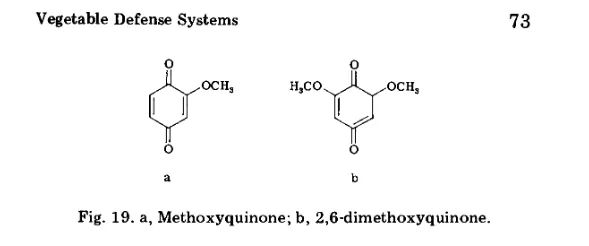
Peroxidase plants, such as citrus fruits do not discolor when damaged , Chemically, the defense structure of these plants relies on maintaining a high Donor/Acceptor ratio, creating a strongly reducing atmosphere through the presence of substances like ascorbic acid (Vitamin C) and methoxyhydroquinones. When mechanical or chemical damage occurs, the hydrogen-activating system becomes inoperative, causing the internal environment to shift from a reducing state to an oxidizing one. This shift, supported by the formation of peroxides that activate the peroxidase, creates a chemical state that is toxic to microorganisms and prevents bacterial growth.
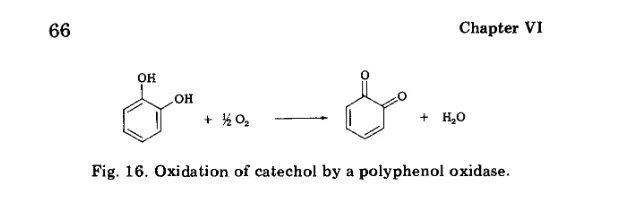
Quinones are too powerful an oxidizing agent to take part in normal respiration. Evidently the quinones are meant to destroy the bacteria which invade the damaged cell.
"The quinones do more than kill bacteria. They tan the protein in fruits and vegetables, making them unfit food for bacteria. The tanned protein forms a protective sheet over the damaged tissue. The dark color seen in the damaged plant is not due to the quinones themselves, which are pale yellow, but to the protein complexes of the quinones. This binding of the quinone by the protein also prevents it from diffusing away and damaging neighboring cells"
Proliferation of microorganisms is suppressed in the vegetable kingdom by hydrogen or electron acceptor which deprive the invading organisms of their active H's or electrons and bind those of the medium, or interfere with the catalytic function of SH groups either by oxidizing their H's or by forming compounds with them.
"Dopa is a nitrogen-containing polyphenol which also can be oxidized by polyphenol oxidase to a highly colored quinone"
"Polyphenol oxidases are known to occur in insects"
THE PEROXIDASE SYSTEM
"The "peroxidase plants" owe their name to the highly active peroxidase they contain"
"I pressed out their juices and added benzidine and peroxide. The expected blue color developed, but in some instances with a short delay of a fraction of a second, while a purified peroxidase developed the color instantaneously. This delay indicated the presence of a reducing agent which re-reduced the oxidized benzidine, so the color could develop only after the reducing agent was oxidized. I isolated the agent; it was an acid. I also found it in greater concentration in the adrenal cortex"
Since "ignosco" means "I do not know," and "ose" means sugar, I called it "ignose." The editor of the Biochemical Journal reprimanded me for making jokes about science. "Godnose" was not any more successful. So, eventually, following a proposal made by the editor, it was called "hexuronic acid"
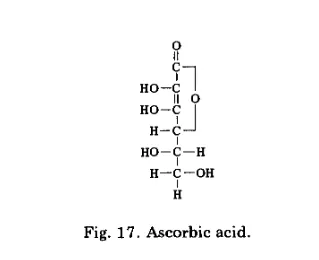
"I considered right from the beginning the possibility that "hexuronic acid" was vitamin C—the unidentified vitamin that prevents scurvy but I did not bother to find out if it was"
"In addition to ascorbic acid I also found an "ascorbic acid oxidase" (1931), an enzyme which could oxidize ascorbic acid in the presence of air to dehydroascorbic acid"
He found that if he eliminated the SH present by oxidizing it, a substance was formed which made the nitroprusside reaction of added SH-glutathione disappear irreversibly"
Chapter 7 - ANIMAL DEFENCE MECHANISM
"Animals, having a blood circulation, can mobilize against microbial invasion the immunological defense mechanism of their whole bodies and need not depend on local reactions. It is only mechanical damage that they have to correct locally by cell division to heal a wound or regenerate a severed part"
"The first simple anaerobic organisms could proliferate freely, limited only by environmental factors such as the availability of food. When a richer energy source was found in light and oxidation, the cells differentiated and more complex multicellular structures resulted."
"When the cell loses its ability to arrest cell division, cancer results"
" The disorder, created by the damage, activates an enzyme system that triggers the correction, which, in the present case, is cell division"
"The chemical machinery of biological oxidation is a rather bulky one. It involves solid state and structure. When the cell divides it has to rearrange its whole interior, which demands mobility. To achieve this the cell has to dispense with its bulky oxidative machine"
"The faster the cell divides the more completely it will have to revert to fermentation from oxidation as shown by O. Warburg (1966). Cell division and anaerobic fermentation are coupled processes"
Proliferation of microorganisms is suppressed in the vegetable kingdom by hydrogen or electron acceptor which deprive the invading organisms of their active H's or electrons and bind those of the medium, or interfere with the catalytic function of SH groups either by oxidizing their H's or by forming compounds with them.
". A C=0 group at the end of an acyclic molecule leads to the formation of an aldehyde, while inside the chain the C=0 leads to a ketone. Ketones are thermodynamically favorable, but are not very reactive. Aldehydes are more reactive but, owing to their hydration, are thermodynamically less favorable."
". The activity of an aldehyde can be
increased by introducing into the molecule a second, conjugated double bond in the a-ß position. The C=C bond is unfit for this purpose because the β C atom is prone to addition, which makes it poisonous and unfit for a reversible, catalytic function. A second double bond can be introduced also by an additional C=0 group. A second aldehydic C=0 gives us glyoxal (Fig. 23). The introduction of a ketonic C O into an alde- hyde in an α position leads to a ketone aldehyde, a "glyoxal derivative," the simplest being methylglyoxal"
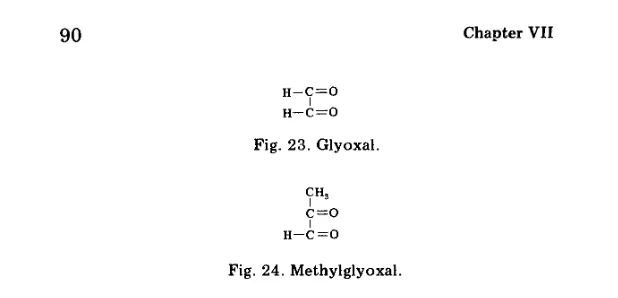
Glyoxalase is not an enzyme but an enzymic system which involves two enzymes, glyoxalase I and II, and a coenzyme, SH-glutathione.
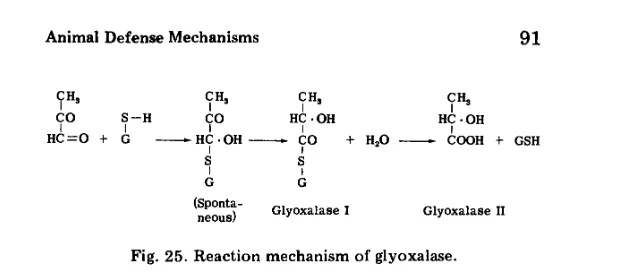
"The function of the glyoxalase, evidently, is to inactivate a ketone aldehyde"
"Ketone aldehydes and pyruvic acid are H or electron acceptors, while lactic acid is, in the presence of latic dehydrase, a good H donor. Ketone aldehydes may thus play an important role in shifting the D/A quotient and the balance between fermentation and oxidation"
"If ketone aldehydes are regulators they should be able to inhibit cell division reversibly without damaging the cell, The substances were tested for their action on the growth of Escherichia coli. "
"methylglyoxal homologs can suppress cell division completely in millimolar concentration, and do this without damaging the cells since the bacteria readily resumed growth as soon as the aldo ketone was decomposed by the glyoxalase present, or was inactivated, be it by SH compounds or ethylenediamine. SH compounds were especially active when they contained two SH's in neighboring positions which enabled them to react simultaneously with both CO groups of the ketone aldehyde"
"Protein synthesis was found strongly suppressed by the glyoxal derivative"
"During the inhibition of protein synthesis the nucleic acids accumulate, All this suggested that aldoketones arrested cell division by interacting with SH groups. By doing so they shut off the H pool and arrest protein synthesis on the ribosome level"
"the specific action of ketone aldehydes on growth and anti bacterial activity could not be explained solely by their electron-acceptor ability."
"hydrazones of ketone aldehydes have a carcinostatic action due to their ability to form chelates with metals and not to the specific action of the aldoketone.(bissemicarbazides, bisthiosemicarbazides, and bisguanidylhydrazones )
"As suggested by the classic studies of 0 . Warburg (1966), the cell has two extreme states: the proliferative anaerobic state and the resting aerobic state. When life originated there was no O2 in the atmosphere, and so life must have started with the proliferative anaerobic state. Later, with the appearance of oxygen and the multicellular state, proliferation had to be suppressed. Perhaps this is achieved by products of the oxidative metabolism, H+ acceptors, which bound the H, the energy source of anaerobic proliferation, and inactivated the SH, The dividing cell, in order to achieve a greater mobility, has to dismount the bulky oxidative mechanism and shunt back, partly or wholly, to the anaerobic energy production. The anaerobic state and proliferation are coupled. The cell can also be forced into this anaerobic state by withholding O2 . If this anaerobic state lasts too long or is induced repeatedly, the proliferative anaerobic state may become constitutive, and the cell may be unable to shift back to the aerobic resisting state even if 02 is reintroduced.
Chapter 8 Cancer
The ability of unlimited proliferation is an attribute of life. In the simplest living forms growth is limited only by environmental factors. In multicellular organisms this potential has to be suppressed in the interest of the organism as a whole, s. In this case the problem is not what makes the cell divide, but what has gone wrong with the mechanism so that it cannot stop?
A cancer cell is comparable to a car on a slope, the question is not what makes it go, but what's wrong with the brake?
A cut is a damage, and a damage can create only disorder, increase entropy, An increase of entropy can activate dormant systems. It can set free the repressed innate ability of proliferation
" It is a sick cell which has to rejuvenate itself by division to stay alive. If division is prevented for a long period of time, the cell has to wither away. Moreover, dividing cells may have an increased energy demand, and if cut off from their energy source by retine they would have to die"
"The production of red blood corpuscles is regulated by the 0 2 tension, whereas the production of white blood corpuscles may be elicited by antigen"
"Since Hammett (1929) called SH "The hormone of cell division," and since Rapkine's pioneering papers(1929, 1930, 1931, 1937) established a relation between SH-glutathione and cell division, a close relationship was suspected between SH and cancer"