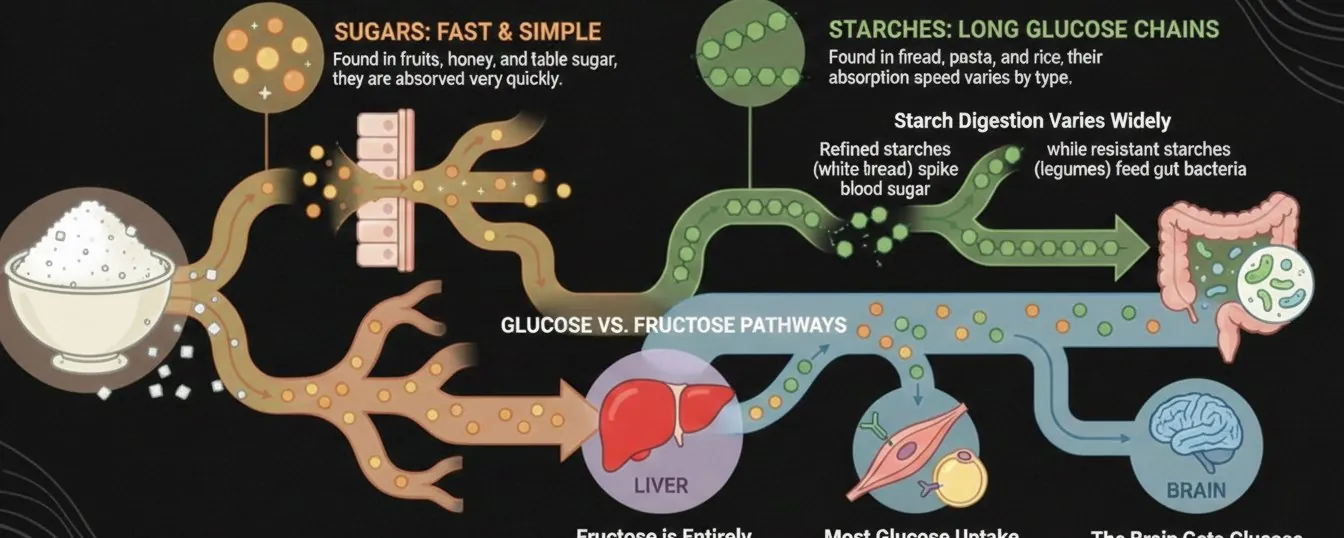
Glucose, Fructose and Starches Distribution
Carbohydrates can be separated to to types
1)Sugars coming from: Fruits,Honey,Table sugar. Those mainly contain Sucrose which is a molecule that contains 50% Glucose and 50% Fructose.
Those get absorbed very fast with less insulin activation
2)Starches coming from: Bread,Pasta,Rice,Oats. Those contain Glucose molecules connected in a long chain.
Starch absorption can be fast or slow depending on the type. Refined or well-cooked starches like white bread or pasta are broken down quickly into glucose, causing a rapid rise in blood sugar and insulin.
Resistant starches like legumes, under-cooked rice, whole graines, resist digestion and can reach the large intestine and get fermented by gut bacteria, Increase bacteria turnover and cause Endotoxin(LPS) production.
LPS was shown to increase inflammation, increase gut permeability and cause cytokine storm as disccused in previous posts)
[PMID: 22723263 , 34200555]
(There is a video I recomend where Georgi Dinkov details this proccess)
)
The main 2 sugars in our diet are Glucose and Fructose and each is getting absorbed and distribted differetnly.
Let's start with glucose, after ingesting it 90%-100% will be carried from the intestine to the blood by SGLT1(Sodium-Glucose Linked Transporter).
SGLT1 is a crucial step in the metabolsim of glucose which dependent on Sodium and Potassium, The small percentage of glucose that will not get absorbed in the small intestine will reach the large intestine, where it will be fermented by gut bacteria.
This fermentation produces gases, can cause discomfort, and contributes to the growth of the gut bacteria, which may increase inflammation in the intestine.
Once Glucose reaches the blood, 5 different transporters takes it into different cells:
GLUT1 takes glucose to red blood cells and thru the blood–brain barrier to the brain, responsible for 10% of the glucose uptake , and is not insulin dependent.
GLUT2 takes glucose & Fructose to liver, pancreatic β-cells, intestine, and kidney, responsible for 20% glucose and 30% of the fructose uptake, and is not insulin dependent.
GLUT3 takes blood to neurons, responsible for 25% of the glucose uptake , and is not insulin dependent.
GLUT4 takes blood to skeletal muscle, heart muscle, and adipose tissue, responsible for 40%-50% of the glucose uptake, and is insulin dependent.
[PMID: 32591906 , 17403369 , 15082519]
When ingesting Fructose, It will get carried by GLUT 2 & 5 which are not insulin dependent. Most of it (around 70%) will go to the liver to be stored as glycogen or converted to glucose. The other 30% will go to other cells like muscle,brain and can be used to generate ATP similarly to glucose.
[PMID: 40549205]
We can notice the Fructose is not dependent on insulin to enter our cells, and only 40% of the glucose is dependent on insulin.
So a good strategy would be to combine Glucose and Fructose together to allow proper entry of Carbs into our cells and minimize Insulin spikes that increase conversion of Carbs to fat.
NOTE that the brain can get glucose without the need of Insulin and as already established in my former post our brain loves glucose and needs it to function properly.
Impact of Carbohydrates can be reduced to a tool called Glycemic index (GI) that gives a score that indicates how quickly a food affects blood sugar levels. It was developed to help understand and categorize foods based on their impact on blood sugar levels, especially for people with diabetes.
A high GI means the food raises blood sugar rapidly, while a low GI means it causes a slower, more gradual increase
Glycemic index (GI)
Fructose 22
Lentils 35-40
Pineapple juice 46
Lactose 46
Peach, canned 47
Grapefruit juice 48
Orange juice 52
Honey 58
Table sugar 60
High fructose corn syrup 62
Sucrose 64
flour bread 67
Taco shells 68
Wheat bread, high fiber 68
Cornmeal 69
Wheat bread, wholemeal flour 69
Melba toast 70
Wheat bread 71
Bagel, white 72
Kaiser rolls 73
Bread stuffing 74
Boiled Potato (white) 78
Rice, Sunbrown Quick 80
Tapioca, boiled with milk 81
Rice, Calrose 87-90
Wheat bread, gluten free 90
French baguette 95
Glucose 96
Maltodextrin 105
Maltose 105
As we can see, Fruits and even table sugar has lower GI then starches like bread and rice so don't get fooled by sugar haters who fear Insulin although Insulin is involved in only 20% of the sugar distribution when both glucose and fructose are consumed.
To conclude, not all carbs we're born the same, Fruits and Honey are great choice and should be incorporated as much in our diets as they contain minerals and vitamins that increase absorption.
Resistent starches should be avoided as they contribute to inflammation.