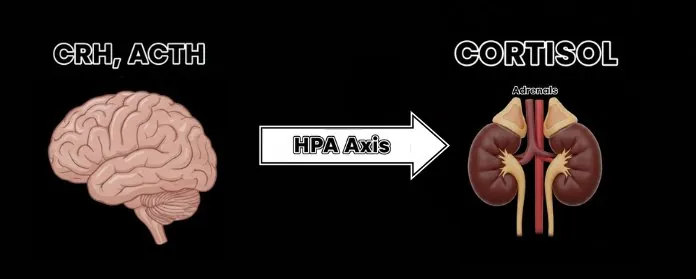
HPA axis & Stress
Everybody has it, everybody talks about it, yet few people have taken the trouble to find out what stress really is. The word “stress,” like “success,” or “failure," means different things to different people, so defining it is extremely difficult although it's part of our daily vocabulary.
In his book "Stress without distress" Hans selye, one of the first endocrinologists to formalize the concept of "stress," described it as "The body's non-specific response to any demand". He discovered that external stressors trigger a hormonal cascade(Now known as the HPA axis) and called it the "General Adaptation Syndrome.
In his research he Identified 3 steps that represents the gradual depletion of cellular energy and the eventual collapse of oxidative metabolism.
The Hypothalamic-Pituitary-Adrenal Axis
Is the main pathway the stress hormones go through, It's the system that manifests stress. It involves 3 glands that spreads "stress" effectively across the body.
Hypothalamus gland: The control center in the brain, when it perceives "stress" it releases Corticotropin-Releasing Hormone a 41 amino acid peptide.
CRH itself is highly inflammatory, especially to the gut and he is known to be involved in IBS and Cron's disease, known to activate mast cells to release histamine and serotonin, Increases Nitric Oxide,NF-kB,PGE2. Involved in leaky gut by Increasing Vascular Permeability. High levels of CRH are found in joints of patients with rheumatoid arthritis, osteoarthritis and Hypothyroid, In addition CRH activates the Pituitary.
Pituitary gland: Secrets Adrenocorticotropic Hormone (ACTH) a 39 amino acids peptide into the bloodstream in response to CRH, ACTH itself is also toxic, inflammatory and catabolic. In brain cells ACTH triggers excitotoxicity by increasing glutamate and lowering ATP, In the gut it activates mast cells and increases gut permeability, allowing Endotoxin (LPS) to enter the blood and cause inflammation and stress.
Adrenal Glands: secretes Cortisol and Aldosterone in response to ACTH. Cortisol is the main stress hormone in the body, It's main rule is to shred any tissue that has amino acids so that the liver can convert them to glucose. Considering that our muscles and all of our organs including the brain, liver, and thymes contain amino acids and express the Glucocorticoid receptor it becomes obvious that raising cortisol is very dangerous and should avoided. It can and will shred any tissue in it's way in order to supply glucose so avoiding sugar might be the easiest way to increase it while consuming enough sugar might be the easiest one to lower it. Although cortisol is very harmful, People doing keto or very low diet should thank god that cortisol exists because without they will die.
Cortisol levels are higher in people with mental diseases,cancer, diabetes, depression. High levels are confirmed to decrease brain size and function.
Cortisol works together with Estrogen, Serotonin ,Prolactin ,Aldosterone and together they destroy oxidative metabolism and everything that makes us humans. Cortisol gets converted from cortisone by the enzyme 11β-HSD that adds Hydrogen to C11. This makes it clear that cortisol is activated when Redox status is shifted towards reduction when Cortisone accepts Hydrogen and becomes activated to Cortisol.
Cortisone/Cortisol ratio is very important and shows stress dominance, it should be at least more than 1 for healthy people and known to decrease in aging and in diseases, It also indicates Redox status similarly to NAD/NADH
[PMID: 40806744,36615866 , 16603131 , 30786242 , 19121282]
Aldosterone is an analog to cortisol but has different action, It is known as the sodium-retaining hormone, When ACTH reaches the adrenals or the renin-angiotensin system gets activated the adrenals release Aldosterone that increases sodium reabsorption from urine while causing potassium and magnesium loss from the cells, causing inflammation and stress response while messing up the mineral balance.
[PMID: 35582177 , 13964048]
In his research Hans Selye Identified 3 steps that represents the gradual depletion of cellular energy and the eventual collapse of oxidative metabolism.
First Stage is "The Alarm Reaction" Upon a stressor, the body immediately activates the HPA axis as a survival mechanism,Releasing CRH, ACTH, Cortisol, shifting the organism from a state of rest to high-alert mobilization.
Second Stage "The Resistance" In an attempt to adapt to sustained stress, the body enters defense mode as gluconeogenesis shredding protein-rich tissues such as brain, muscle ,thymus gland, sends them to the liver that converts them to glucose to insure survival, this is toxic process that burdens the liver, In addition it raises free fatty acids levels that block the usage of glucose, This is where most people stuck, their health feels like going down but they are still managing to survive.
Third stage is "The Exhaustion Stage" This final stage occurs after a while of cortisol dominance, when adaptive resources are entirely depleted and the cell shifts into a permanent reductive state(low NAD/NADH), ATP production has been low for a long time that the cells start to dismantle their electron transport chain as they lost hope of oxidative metabolism This metabolic failure triggers cancer, diabetes, neurodegeneration, mental breakdown.
Hopefully we can block this even before stage 1 begins, by optimizing health, stage 2 is most common and still gives high chance of restoring metabolism and energy while stage 3 would be the hardest and longest to recover from.
My 6 strategies to minimize cortisol
1. Build up your sugar intake until you can metabolize 4-5g of carbs per kg of bodyweight, mainly from simple sugars, make sure your potassium, b1,b3 intake is also high to support glucose metabolism, build up slowly.
Cortisol main rule is to shred tissue to supply glucose for your cells when they don't have any, The easiest way to inhibit cortisol is to make sure your cells have enough glucose, If you that your body won't release cortisol.
2. Being in the sun for at least 1 hour a day. sunlight and long light waves signal safety to your nervous system, increases vitamin D, Testosterone and DHT while lowering cortisol and other stress hormones, If you can also ground yourself the effect gets greater.
3.blocking serotonin as much as possible, serotonin is capable of activating the HPA axis Independently, consuming salt and enough potassium is needed to secrete it, avoiding Resistant starches that can trigger endotoxin and serotonin release, endotoxin also activates the HPA axis.
4.Avoid PUFA, eat a lot of coconut oil, Omega 3,6 activates the HPA axis increases inflammation and endotoxin while coconut oil was shown to lower cortisol and stress hormones.
5. Avoid exhaustive exercise, during hard workout or long runs the body will increase cortisol levels to supply glucose by shredding muscles, This happens once your glycogen levels are depleted which happens around 1h of training, eating a lot of sugar before and after my workout has huge effect on my energy levels, performance and recovery.
6.Have impactful life, doing things you enjoy, Interacting with people you love and trust, avoiding high screen time and doom scrolling as they raise serotonin and cortisol.
Hope this helped you understand the stress system, now you can start to lower it!
More studies on the HPA axis
1. Justin B, Sarah C Conner et al... Circulating cortisol and cognitive and structural brain measures: The Framingham Heart Study 20;91(21):e1961-e1970.
2. yvette Tachéa and Stefan BrunnhuberFrom Hans Selye’s Discovery of Biological Stress to the Identification of Corticotropin Releasing Factor signaling pathways: Implication in Stress-Related Functional Bowel Diseases 1148: 29–41
3. L Alberti1 , A Girola1 Type 2 diabetes and metabolic syndrome are associated with increased expression of 11b- hydroxysteroid dehydrogenase 1 in obese subjects 1826–1831
4. T C Theoharides 1, L K Singh Corticotropin-releasing hormone induces skin mast cell degranulation and increased vascular permeability, a possible explanation for its proinflammatory effects 139(1):403-13
5. Jing Cao 1, Nikoletta Papadopoulou, Human mast cells express corticotropin-releasing hormone (CRH) receptors and CRH leads to selective secretion of vascular endothelial growth factor 15;174(12):7665-75